
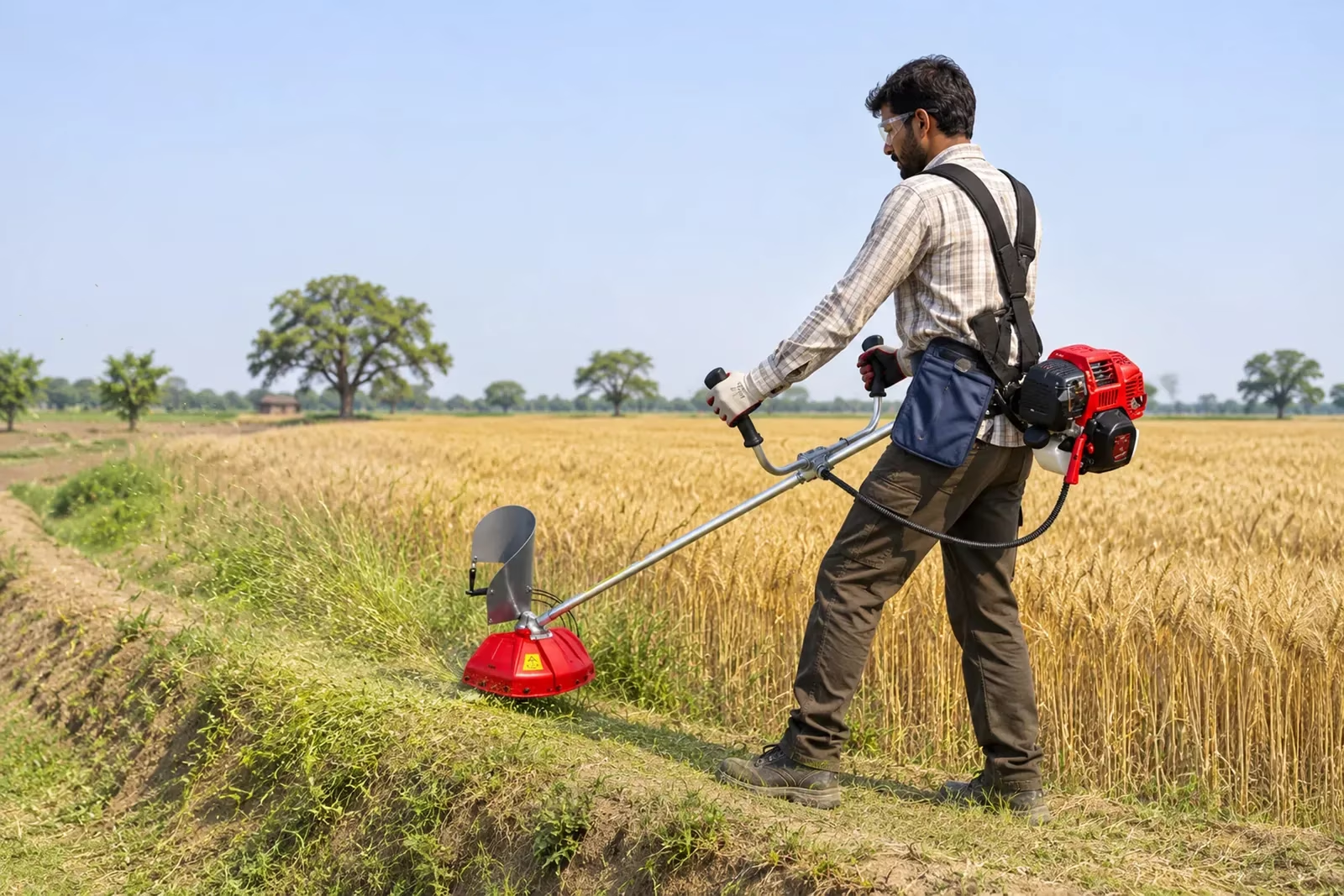
Short answer: For wheat weedicide spraying, use 200 litres of water per acre within two days of sowing, or 150 litres for post-emergence sprays, mostly at 30 to 45 days. Fit a flat fan nozzle, hold it about 1.5 feet above the crop, walk straight and overlap each pass by 30%.
Weed control in wheat starts within days of sowing and runs to about six weeks after. When weeds survive a weedicide spray, check how it was put on before you blame the product: the water per acre, the nozzle, and the stripes left between passes.
The most detailed public spraying guidance for wheat comes from Punjab Agricultural University (PAU), whose Rabi 2025-26 package lists weedicides with their timing and water volume1. Punjab's weeds and soils differ from Madhya Pradesh's, so take the herbicide choice and dose from your label and your local KVK or the agriculture department. The application method below holds anywhere.
Wheat Weedicide Spraying: Match the Timing to the Window
PAU's wheat table gives three windows1:
- Pre-emergence: spray "within two days of sowing using 200 litres of water". PAU adds: "Good soil moisture for pre-emergence spray is desirable."
- Post-emergence, before first irrigation: some herbicides go on when the "crop is 20 days old and weeds are in 2-3 leaf stages", sprayed "2-3 days before first irrigation, using 150 litres of water".
- Post-emergence, after first irrigation: most grass and broadleaf weedicides in the table are listed at "30-35 days of sowing" or "35-45 days after sowing", most of them "using 150 litre of water".
The window and the weed stage are printed on the pack. Follow them.
Water: 150 Litres per Acre Is the Usual Figure
PAU's spray technology chapter says: "Always use 200 litres of water for pre-emergence herbicides at the time of sowing and 150 litres of water per acre for post emergence application"1.
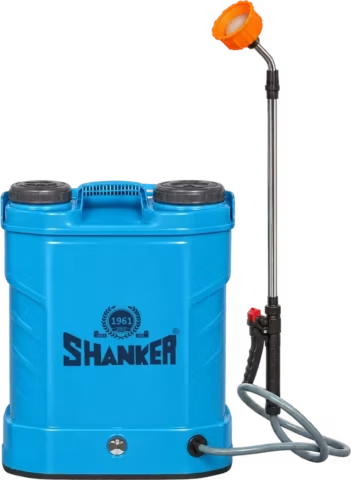
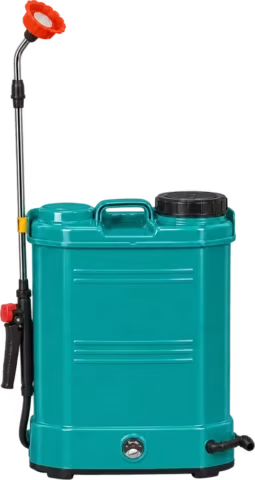
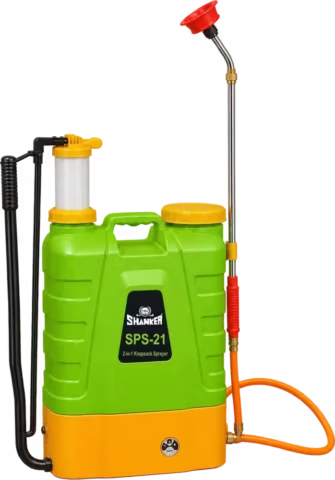
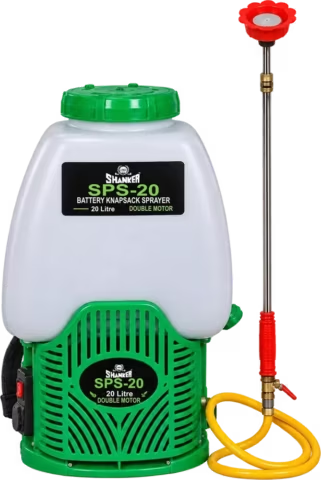
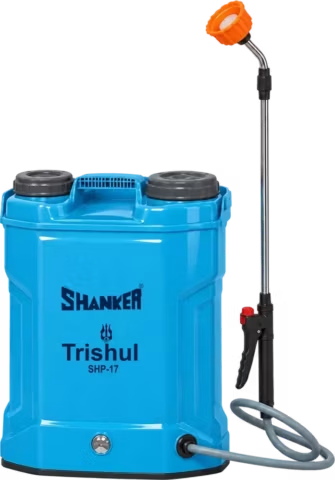
With a 16 L battery sprayer such as Ganesh SHP-12 or Trishul SHP-17, 150 litres is about 9 to 10 tank fills per acre. With a 20 L sprayer such as Mahadev SHP-21 or SPS-20, it is 7 to 82. Find your own figure by calibrating on plain water first.
To spread the dose evenly, PAU suggests dissolving one acre's dose in a small stock solution and adding an equal share to each tank1.
Nozzle: Flat Fan for Post-Emergence
PAU's wheat notes say: "Use flat fan or flood jet nozzle for pre-emergence herbicides and flat fan nozzle for post emergence herbicides"1. Its crop-wide note says: "For proper control of weeds, it is always necessary to use flood jet or flat fan spray nozzles"1.
The ICAR Directorate of Weed Research, Jabalpur, describes the standard flat fan as the "Main nozzle used in broad-scale spraying" of herbicides3. The national IPM packages give the lever-sprayer setting for weeds: "Flat fan or flood jet nozzle @ 15 to 20 psi", with "Lever operating speed = 7 to 10 strokes/min"4.
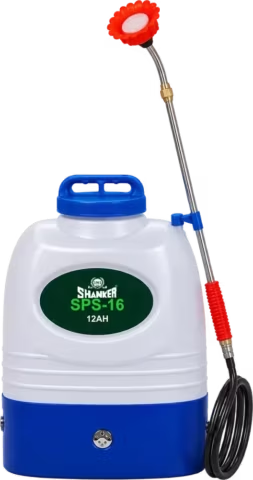
Several SHANKER battery sprayers, including SHP-12, SHP-17, SHP-19, SPS-16 and SHP-21, come with a flat fan nozzle in the box2.
Walking Pattern: Straight Strips, Steady Height, Enough Overlap
- Height: PAU: "Maintain nozzle height around 1.5 feet from the crop canopy"1.
- Lance: "Always spray in strips by keeping the spray lance straight. Do not move the spray lance to and fro"1. Swinging the lance puts a double dose in some places and none in others.
- Overlap: the DWR scientists say "a proper spray overlap of 30 % in flat fan nozzle and 50 % in flood jet nozzle is essential"3. Mark your passes with pegs or walk along a seed row so the next strip overlaps the last.
- Pace: keep the same walking speed you used when you calibrated.
- Weather: PAU: "Spray should be as uniform as possible and on clear days" and "Spray should be done on calm days"1.
Which Sprayer for Wheat Weedicide
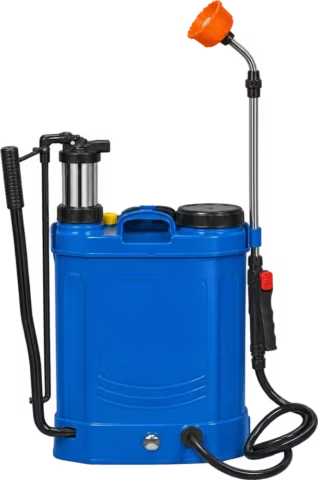
Any knapsack with a flat fan nozzle can do the job. What changes is the time it takes. PAU lists a manual knapsack sprayer at "1.5-1.75 acre/day"1. A battery sprayer saves the pumping effort, and the 2 in 1 Parvati SHP-18 and Nandi SPS-21 can be pumped by hand if the battery runs down before the field is finished2.
For wider fields, PAU suggests: "Use multiboom nozzles for uniform spray"1. Whatever you use, calibrate it on plain water first so that you know your real litres per acre at your own walking pace.
After the Spray
- Irrigation: "After spray, irrigation should be light as heavy irrigation reduces the efficacy of herbicides"1.
- Escapes: "Some weed plants may escape after the application of herbicides. These plants should be uprooted before they produce seeds"1.
- Resistance: "Change the herbicide group every year to prevent the development of resistance in weeds"1.
- Mixed crops: if mustard, raya or gram is sown in the wheat, several broadleaf weedicides in PAU's table must not be used. Check the pack1.
Clean the Sprayer Before Any Other Crop
Weedicide left in a tank can damage the next crop you spray. PAU's instruction: "After spray, flush the spray pump thoroughly with water and then with washing soda solution (0.5%) to remove traces of herbicides, as contaminated spray pump may be phytotoxic when used for spray on other crops"1. It also advises: "If possible, keep separate pumps for spraying herbicide and other pesticides"1.
One simple way to follow that advice: keep an older sprayer, or a manual SRP-4 or Hitech SRH-5, for weedicide only and use the main battery sprayer for insecticides and fungicides2. Mark the herbicide sprayer clearly.
FAQ
PAU advises flat fan for post-emergence herbicides1. Cone nozzles are for insects and diseases.
PAU's figure for post-emergence herbicide is 150 litres per acre1. Too little water means poor coverage. Check your label too.
That depends on your weeds and your soil. Ask your KVK or agriculture officer, and follow the label dose.
Sources
- Punjab Agricultural University, Package of Practices for Crops of Punjab, Rabi 2025-26, Wheat "Weed control" with "Useful hints", the "CAUTION" note, and chapter 11 "Spray technology": pau.edu Back to Text
- SHANKER product brochure (2022), battery and manual knapsack sprayer pages. Back to Text
- Chethan C. R. and others, ICAR Directorate of Weed Research, Jabalpur, "Herbicide application in agriculture: nozzle selection and effective application", Indian Farming 68(12), December 2018: epubs.icar.org.in Back to Text
- Directorate of Plant Protection, Quarantine and Storage and NIPHM, Integrated Pest Management Package for Soybean (2014), application protocol, Category C: Weeds: niphm.gov.in Back to Text