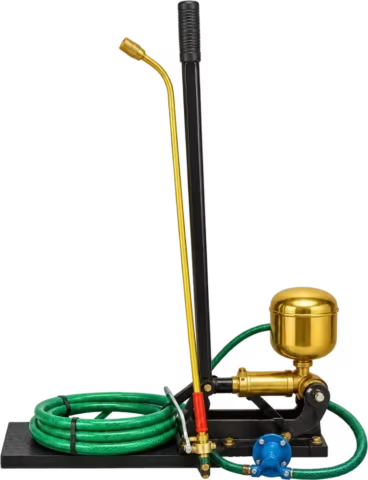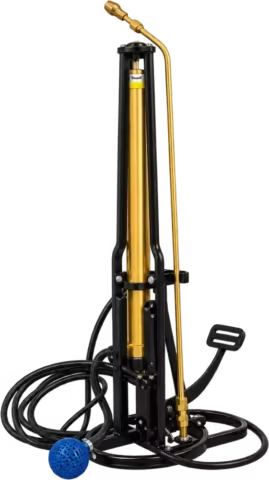

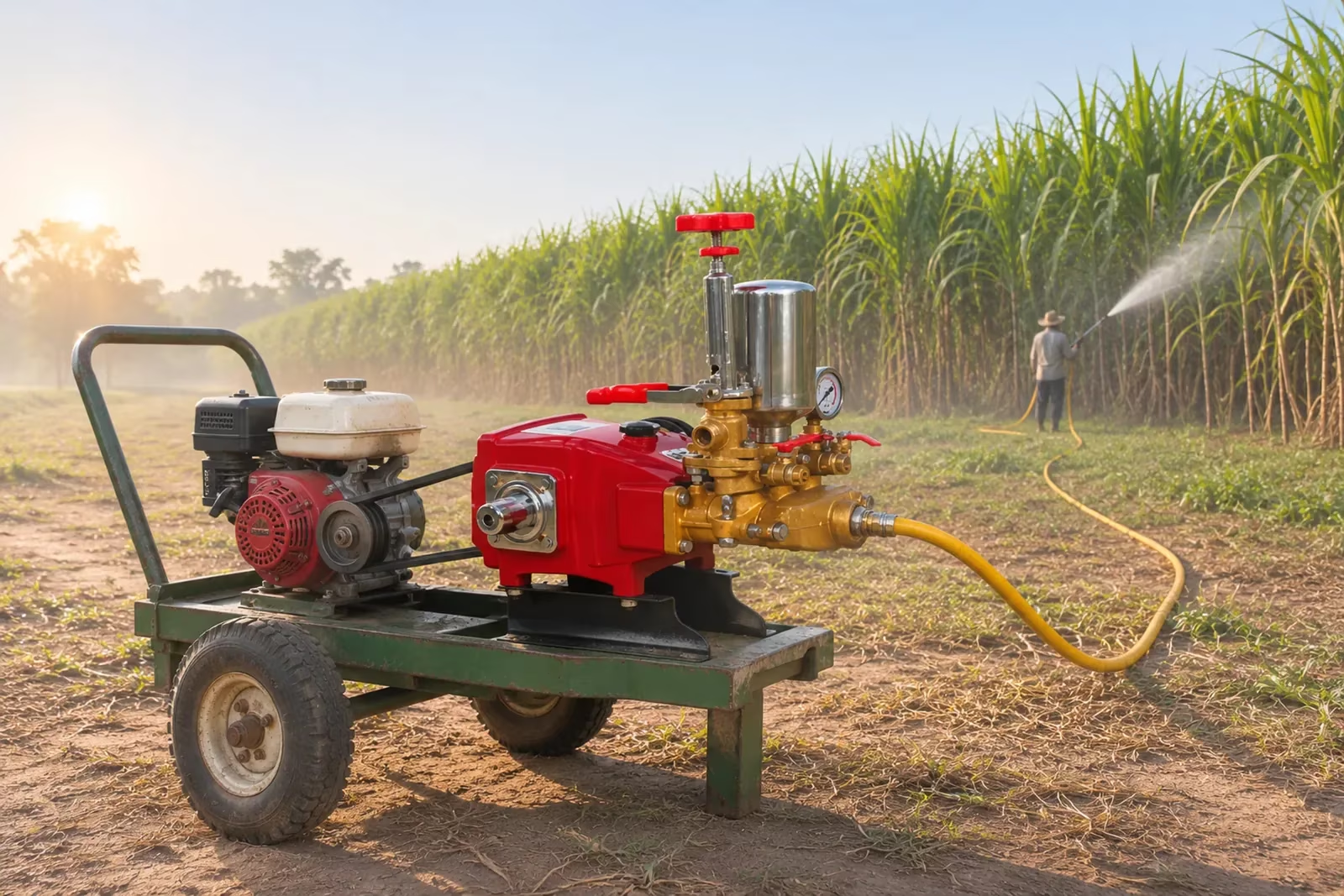
Short answer: An HTP power sprayer is a ground pump with an engine or motor, a drum, a long hose and a gun. For fruit trees use a working pressure of 30 to 35 kg/cm²; taller trees need more flow, so choose between 65, 75 or 95, and 120 litres per minute by tree height and number.
Fruit trees are the hardest crop to spray well. Scientists at ICAR's Central Institute of Agricultural Engineering in Bhopal describe orchard spraying as "a challenging task considering various sizes, shape, and geometry of orchard canopies, underside droplet deposition, high diluents requirement, frequent spraying and off target drift losses"1.
For a tall tree, the spray has to be thrown upward from the ground. That is the job of an HTP power sprayer: a ground pump driven by an engine or motor, feeding a long hose and a spray gun.
What an HTP Power Sprayer Set Is Made Of
An HTP set has four parts:
- The pump. Its job is to build pressure and flow.
- The power source. An engine or electric motor of the horsepower the pump needs. The brochure lists SHANKER's pumps without one2, so confirm what your dealer supplies.
- The tank. A drum or tank of spray mix near the trees. The pump draws from it.
- The hose and gun. SHANKER lists hose pipe in 8.5 mm and 10 mm sizes2, and a range of spray guns: Hi-Jet guns from a 1 foot chrome gun to 2 feet heavy, extra heavy, stainless steel and Italian guns, half brass guns of 2 and 3 feet, and Alap turbo and turbine guns2.
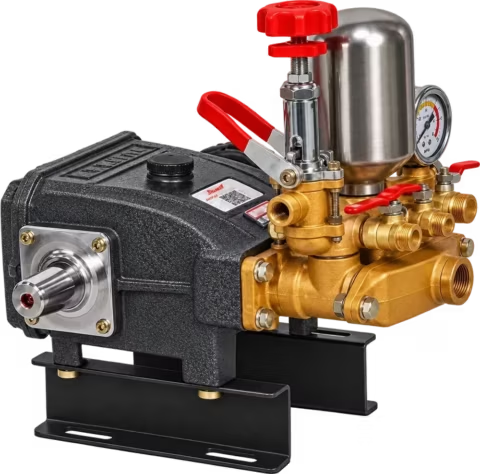
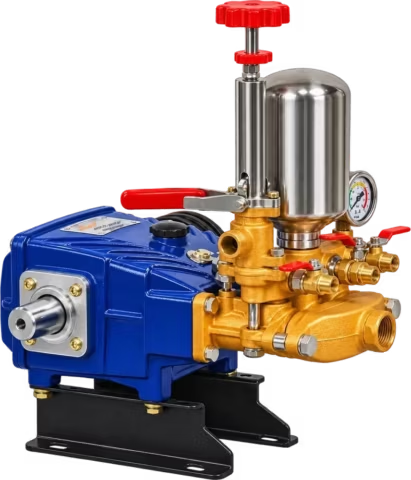
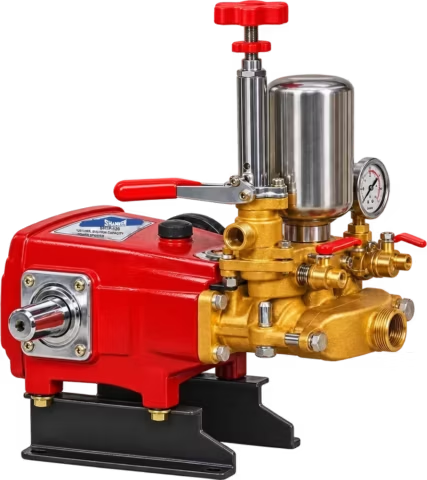
SHANKER makes three HTP pumps2:
- SHTP-65: 65 L/min suction capacity, needs 3 HP
- SHTP-75 / SHTP-95: 75 or 95 L/min, needs 3 HP or 5 HP
- SHTP-120: 120 L/min, needs 5 HP
All three have a brass pump cylinder body and three steel plungers of 30 mm diameter and 23 mm stroke, run at 800 to 1000 rpm, and work at 30 to 35 kg/cm² with a maximum of 45 kg/cm²2.
Matching the Pump to Your Trees
Pressure and flow both matter. The Alabama Cooperative Extension System's guide on orchard sprayers says a hand-gun sprayer "must provide and maintain high pressure and sufficient flow of liquid so the large droplets of the stream can reach the tops of the trees"3. Its table pairs taller trees with bigger pumps, rising from 3 gallons per minute for trees "Up to 15" feet to 15 gallons per minute for trees of 30 to 45 feet3. That table is for American equipment. The point to carry over is that taller trees call for more flow as well as pressure.
In SHANKER terms, the SHTP-65 is the smallest pump and the SHTP-120 the largest, at 120 L/min2. For a few trees near the house, a smaller set is enough. For a large block of old, tall trees, the larger pumps give more flow to work with.
Hose Length and Pressure Loss
Thin hose loses more pressure to friction on the way to the gun. The Alabama guide notes "the decrease in pressure caused by friction in small-diameter hoses"3. Use the shortest hose that reaches the trees comfortably, and the wider hose for long runs.
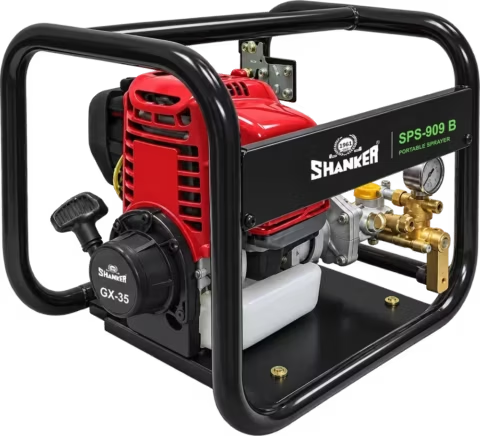
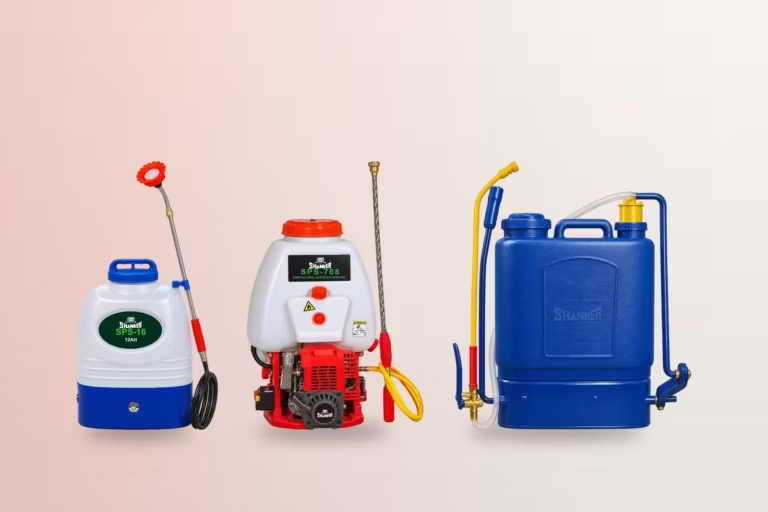
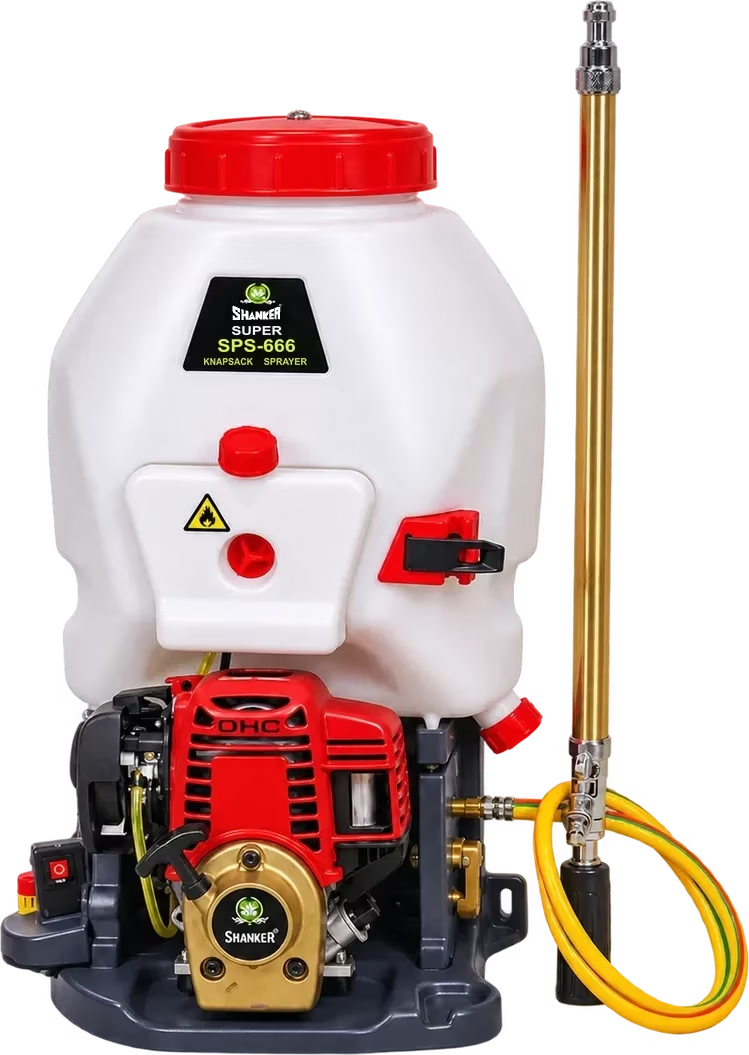
For a lighter set-up, the SHANKER SPS-909 B portable sprayer has a 35 cc GX-35 engine, a 1 foot gun, sprays 550 to 600 litres per hour, and the brochure says its "delivery hose can be used up to 100 meter length"2. For small orchards without an engine, the Hillor HR-14 rocking sprayer and Everest ET-8 foot sprayer take delivery hose "max 100 mtr" and come with a 90 cm extension rod bent as a gooseneck2.
How Much Spray per Tree
The government's IPM package for mango gives spray volumes by tree for some treatments, such as "5-15 l per tree" and "10 l/ tree", and acre volumes for others, such as "600-800 l of water/acre"4. Several entries say the amount depends "on the size of the tree canopy"4.
Two practical steps follow from that:
- Calibrate by the tree. Time how long it takes to cover one average tree properly, and measure the litres used. Multiply by the number of trees to know how much mix to prepare.
- Prepare in batches. Mix one drum at a time, so leftover mix is small.
The same package lists, under powdery mildew, "Spraying at full bloom needs to be avoided"4. Plan sprays around flowering with your KVK's advice.
Spraying Technique
- Adjust the gun. The Alabama guide explains that a variable-angle gun "controls the spray angle from a wide-angle spray for short trees and shrubs to a narrow stream for tall trees. The handle of the gun can be twisted to control the spray angle"3.
- Cover all sides. Walk round the tree. Spray the inside of the canopy and the underside of leaves as well as the outer face.
- Work with the wind. The national IPM packages advise: "Do not apply against the wind direction" and "Do not apply on hot sunny day or strong windy condition"5.
- Mind the people around you. An HTP stream travels far. Keep children and animals out of the orchard while you spray.
Pump Care
- Clean water and a strainer. Draw from clean water and keep the suction strainer in place, so grit does not reach the plungers and valves.
- Flush after use. Run clean water through the pump, hose and gun after every spraying day.
- Seals and valves. If pressure falls or the pump leaks, have your dealer check the seals, packing and valves before the next season. For SHANKER's petrol knapsack piston pumps, the spares list includes V-packing, gland seals, valve assemblies and plungers2; ask which parts fit your SHTP model.
- Engine. Look after the engine as its manual asks: oil, air filter and fresh fuel. See our petrol engine care guide.
Safety at High Pressure
The pump works at 30 to 35 kg/cm²2. Check the hose and clamps before each use, never point the gun at a person, and wear the full protective kit described in our safety guide. Rule 39 of the Insecticides Rules lists overalls, impermeable gloves to half the forearm, dust-proof goggles and boots for anyone applying insecticides6.
FAQ
Yes, if you change the gun. The SHANKER range includes long guns for trees and multi-nozzle guns for crops2. Wash the system between different chemicals.
The answer depends on tree height and how far the trees are from water. Tell your dealer both, and try the gun on water first.
Follow the pump maker's instructions. The SHANKER knapsack pump spares list includes an oil gauge and grease cup for its piston pumps2; ask your dealer which applies to your SHTP model.
Sources
- Thorat D. S., Jyoti B. and Khadatkar A., ICAR Central Institute of Agricultural Engineering, Bhopal, "Precision spraying technologies for orchard crops", Indian Horticulture, July to August 2022: epubs.icar.org.in Back to Text
- SHANKER product brochure (2022), HTP power sprayer pages, SPS-909 B portable sprayer, HR-14 and ET-8, knapsack pump accessories page, and Hi-Jet spray guns and hose page. Back to Text
- Alabama Cooperative Extension System, "Sprayers for Orchard Maintenance", ANR-0053-P (April 2025), "Handgun Sprayers" and Table 1: aces.edu Back to Text
- Directorate of Plant Protection, Quarantine and Storage and NIPHM, AESA based IPM: Mango: niphm.gov.in Back to Text
- Directorate of Plant Protection, Quarantine and Storage and NIPHM, Integrated Pest Management Package for Cotton (2014), "Precautions for applying pesticides": niphm.gov.in Back to Text
- The Insecticides Rules, 1971, rule 39: py.gov.in Back to Text