
Short answer: Pesticide spraying safety starts with the label: red is extremely toxic, yellow highly, blue moderately and green slightly toxic. Wear overalls, gloves to half the forearm, goggles, boots and a mask, mix with a long stick, never spray against the wind, and wash with soap after.
The person mixing and spraying stands closest to the chemical. India's Insecticides Rules, 1971, already set out what protective clothing should look like and how labels must warn about toxicity1. University and government spraying guides add the practical steps23.
This post puts those rules in plain words for a farm in central India.
Read the Triangle on the Label
Rule 19 of the Insecticides Rules requires every label to carry a diamond-shaped square, split into two triangles. The lower triangle carries a colour band that shows how toxic the product is1:
- Bright red: Extremely toxic. The upper triangle shows a skull and crossbones and the word "POISON" in red.
- Bright yellow: Highly toxic. The word "POISON" in red.
- Bright blue: Moderately toxic. The word "DANGER".
- Bright green: Slightly toxic. The word "CAUTION".
Red, yellow and blue labels must also say "KEEP OUT OF THE REACH OF CHILDREN"1. Green does not mean safe. It means less toxic than the others. The national IPM packages ask extension staff to teach farmers to use this "colour toxicity triangle" because farmers "can follow the colour and corresponding safety precautions"4.
Before you open any pack, PAU's advice is simple: "Read carefully instructions given on pesticide label and follow the same"2.
Pesticide Spraying Safety: The Protective Kit
Rule 39 of the Insecticides Rules says people handling insecticides during "application, shall be adequately protected with appropriate clothing"1. It lists a complete suit as1:
- "Protective outer garment / overalls / hood / hat"
- "Rubber gloves or such other protective gloves extending half way up to the fore-arm, made of materials impermeable to liquids"
- "Dust-proof goggles"
- "Boots"
The clothing must "prevent or resist the penetration of any form of insecticides formulations" and be washable "so that the toxic elements may be removed after each use"1.
Rule 40 covers breathing. For "preventing inhalation of toxic dusts, vapours or gases", it lists chemical cartridge respirators and gas masks among the suitable types1.
PAU's spraying chapter puts it in field terms: "Wear hand gloves for preparation of spray fluid, and gas mask, full sleeve shirt and trousers during spraying"2.
If you do not have the full kit, the government IPM package for cotton gives a fallback: "Use polyethylene bags as hand gloves, handkerchiefs or piece of clean cloth as mask and a cap or towel to cover the head", and protect "bare feet and hands with polyethylene bags"3. This is the minimum, not the goal.
Mixing the Spray
Mixing is the step where you handle the undiluted concentrate.
- "Do not tear open the pesticide packet but use scissor or knife for this purpose"2.
- Mix "in drums using long sticks to protect the operation from splashings and to permit stirring from a standing position"2.
- "Concentrated pesticides must not fall on hands etc. while opening sealed containers"3.
- "Do not smell the sprayer tank" and avoid "spilling of pesticide solution while filling the sprayer tank"3.
- "Do not eat, drink smoke or chew while preparing solution"3.
While Spraying
- Weather: "Do not apply on hot sunny day or strong windy condition" and "Do not apply against the wind direction"3. PAU: "Spray should be done on calm days"2.
- Who sprays: "Only healthy person without any wound on body should be engaged for spraying" and "Do not spray on an empty stomach"2.
- Hours: "Operator should not work for more than 8 hours a day"2.
- A blocked nozzle: "Do not blow the clogged nozzle"2. Take it off and clean it with water and a soft brush.
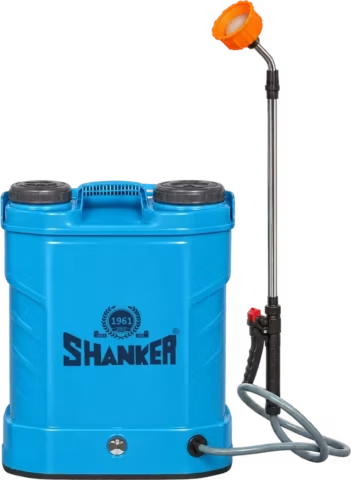
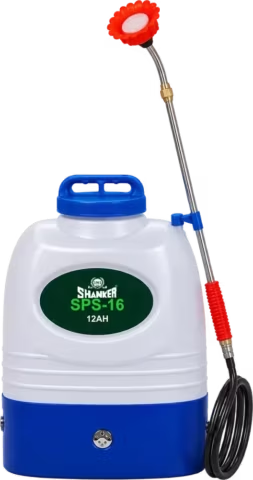
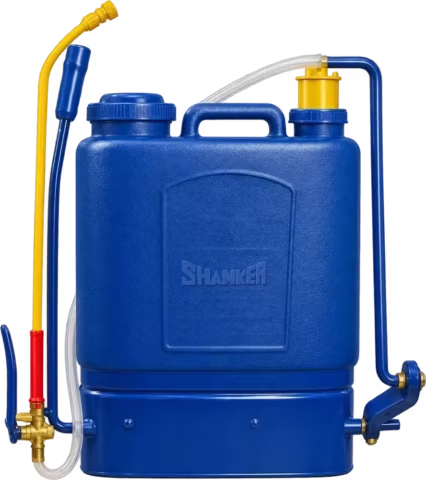
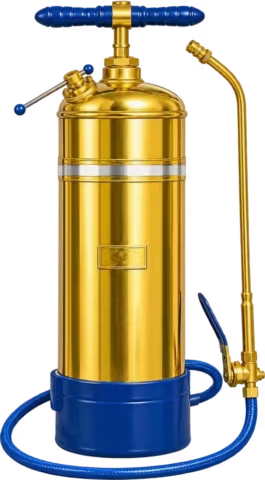
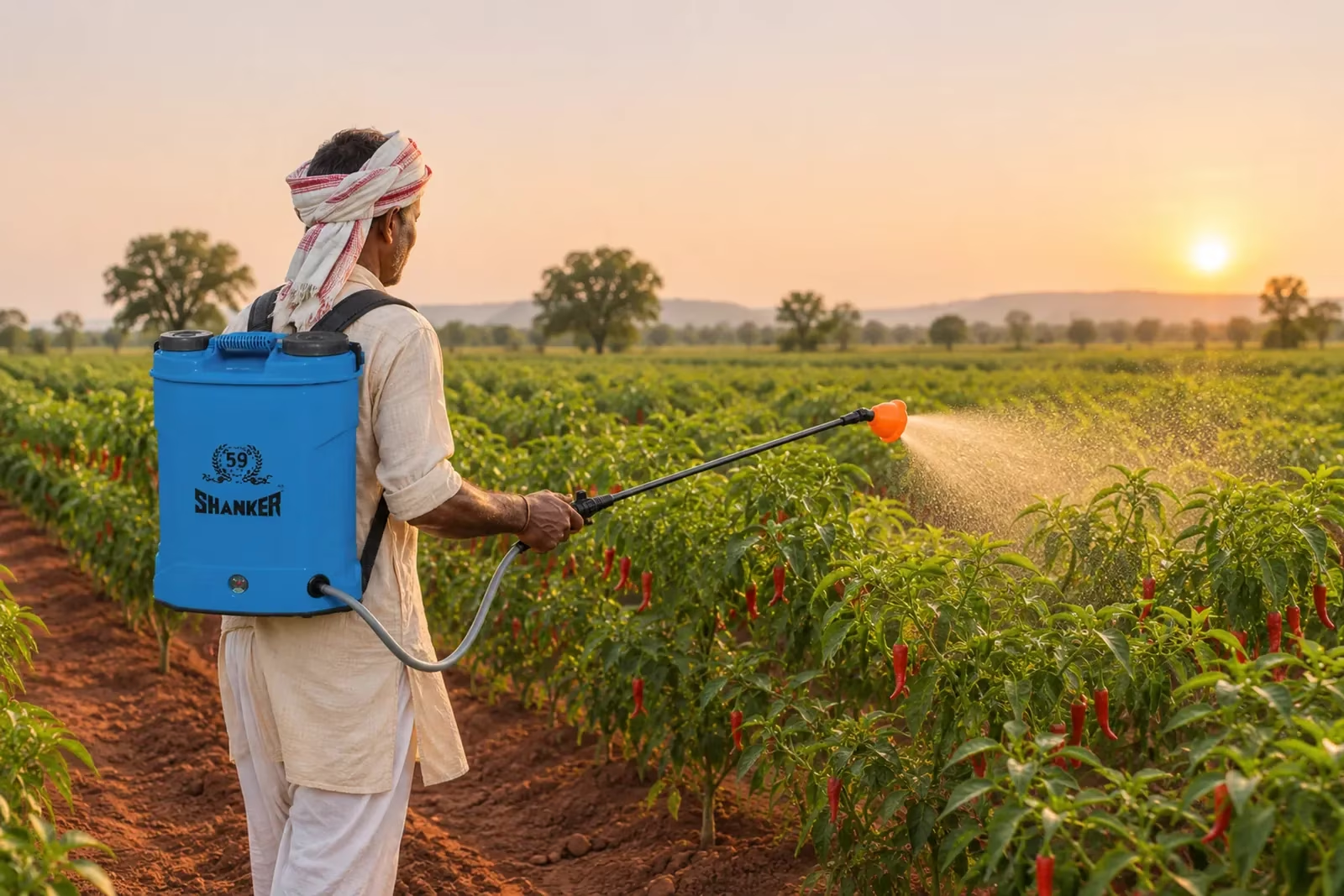
- Leaks: "Do not use leaky, defective equipment"3. A leaking tank lid or hose joint soaks your back and legs. Check the tank cap, cap rubber and hose before you fill.
- After spraying: "Avoid entry of animals and workers in the fields immediately after the spraying"3.
Washing Up
- "The worker should not smoke, chew, eat or drink while spraying and must wash hands and feet thoroughly with soap and water after handling or use of pesticide"2.
- "Wash the sprayer and bucket etc. with soap water after spraying"3.
- Do not reuse mixing buckets for the home: "Containers, buckets etc. used for mixing pesticides should not be used for domestic purposes"3.
- Wash spraying clothes separately, every time. The rules require protective clothing to be washable so residue can be removed "after each use"1.
Storage and Disposal
- Store "in a safe and locked place, out of the reach of children, irresponsible persons and pets" and "Never store pesticides near foodstuffs or medicines"2.
- "Keep pesticides in labelled containers only"2.
- Leftover spray "should not be drained in ponds or water lines"3.
- Empty containers: "Do not use the empty containers of pesticides for any purpose. Destroy them by making holes"2. The IPM package adds that they should be "crushed with a stone /stick and buried deep into soil away from water source"3.
If Someone Feels Unwell
Stop spraying and get the person to the nearest doctor or Primary Health Centre without delay. Take the pesticide container and its leaflet with you.
Rule 18 of the Insecticides Rules requires the leaflet in every pack to give "the symptoms of poisoning", "emergency first-aid treatment where necessary" and "the antidote for the poison"1. Read that leaflet before you spray, not after. The government IPM packages also ask that the leaflet "must be made available to the doctors in the vicinity of plant protection operations"4.
FAQ
The chemical and the dose are the same, so the protective kit is the same. What you can control is the machine's condition: a sound tank cap and leak-free hose keep the mix off your back.
Sources
- The Insecticides Rules, 1971 (as amended), rules 18, 19, 39, 40 and 44, text hosted by the Government of Puducherry: py.gov.in Back to Text
- Punjab Agricultural University, Package of Practices for Crops of Punjab, Rabi 2025-26, "Precautions during spraying": pau.edu Back to Text
- Directorate of Plant Protection, Quarantine and Storage and NIPHM, Integrated Pest Management Package for Cotton (2014), safety sections D to G: niphm.gov.in Back to Text
- Directorate of Plant Protection, Quarantine and Storage and NIPHM, Integrated Pest Management Package for Soybean (2014), section 7.0 "Safety parameters in pesticides usage": niphm.gov.in Back to Text