
Short answer: This chilli spraying guide, which also covers onion and gram (chana), comes down to one rule: check the field every week and spray only when the pest count or the damage calls for it. Use the water volume on the label, which for most chilli, onion and gram sprays in the government IPM packages works out to about 200 litres an acre or more, with a cone nozzle for insects and diseases.
If you grow chilli, onion or gram in Malwa, one sprayer often has to serve all three crops. Each crop has its own main pests, its own way of scouting and its own water figure. This guide brings those together from the Government of India IPM packages for chilli, onion and chickpea, written by the Directorate of Plant Protection, Quarantine and Storage (DPPQS) and NIPHM 123. Scientists from Jabalpur helped write the chickpea and onion packages 23. For gram we also use Punjab Agricultural University (PAU) 4.
We could not find a current Madhya Pradesh package of practices online for these crops. Where the national and Punjab figures differ, ask your local KVK which one fits your district.
We do not name any chemical or dose in this guide. That comes from the label and your KVK.
Before Any Spray: Scout, Count, Then Decide
All three government packages give the same weekly routine. Walk the field once a week, in the morning, "preferably before 9 a.m." 123. Count the pests, and count the friendly insects too: ladybird beetles, spiders, lacewings and the like.
The chilli and onion packages do not use a fixed pest count. They compare pests with their natural enemies, which they call the P: D (pest to defender) ratio. The chilli package says "The general rule to be adopted for management decisions relying on the P: D ratio is 2: 1" 1. When the friendly insects are keeping up, the package says "there is no need for adoption of other management strategies" 1.
Traps tell you when moths arrive, before the larvae do damage:
- Pheromone traps for pod borer (Helicoverpa) and tobacco caterpillar (Spodoptera) moths 13.
- Blue sticky traps for thrips in onion and chilli 12.
- Count the moths each week and remove them from the trap 13.
Chilli Spraying Guide: Pests, Timing, Water and Nozzle
Main pests and diseases of chilli
The national chilli package lists these as pests of national importance 1:
- Insects and mites: gram pod borer, tobacco caterpillar, thrips, aphids, spider mites and yellow mites.
- Diseases: damping off, die back and fruit rot, Choanephora blight, mosaic, powdery mildew, Cercospora leaf spot, bacterial leaf spot, Fusarium wilt, Alternaria leaf spot and leaf curl virus.
Thrips need extra care. In 2022 the Government of India issued a separate advisory on an invasive thrips, Thrips parvispinus, after it "caused significant damage" in chilli in Andhra Pradesh, Telangana and Karnataka in Rabi 2021-22 5. Its adults "mainly colonize on flowers and underside of leaves" and the infestation "causes heavy flower drop" 5.
When to scout chilli and when to spray
Start checking "soon after crop establishment after transplanting and at weekly intervals thereafter" 1.
- Thrips: count them on five top leaves per plant 1.
- Aphids and mites: count them on five leaves per plant, picked at random 1.
- Pod borer and tobacco caterpillar: count the damaged fruits and the larvae on each plant 1.
- Traps: put up pheromone traps at 4 to 5 per acre for the moths, and blue sticky traps at 4 to 5 per acre for thrips 1.
We did not find an official threshold count for chilli pests. The package works on the 2:1 pest to defender rule above, and your KVK can tell you the local practice 1.
Two timing rules from the package:
- Do not spray at midday. The package says "most of the insects are not active during this period" 1.
- For pests that come out at night, such as the tobacco caterpillar, spray when they appear in the evening 2.
For the invasive thrips, the government advice is to rely on "target specific insecticides (only if necessary) instead of insecticide mixtures", and to treat chemicals as the "Final resort" 5.
Water per acre for chilli
Most spray entries in the chilli package use "200 l of water/acre", with some products listed from 120 up to 400 litres 1. The government list of approved thrips insecticides for chilli gives most products "in 500 litre" of water per hectare 5. That is about 200 litres an acre.
At 200 litres an acre, a 16 L tank is about 12 to 13 fills per acre. Check your own figure with the knapsack sprayer calibration method before you mix.
Nozzle and aim for chilli
For insects and diseases, the package gives a lever knapsack with a "Hollow cone nozzle @ 35 to 40 psi" and "15 to 20 strokes/min" 1. Wet the underside of the leaves. The package says: "Spray pesticides thoroughly to treat the undersurface of the leaves, particularly for mites, whiteflies, Spodoptera etc." 1. More on tips and pressure in our sprayer nozzle guide.
Before you pick chilli
Chilli is picked many times, so the gap between spray and picking matters. The package says "Do not apply pesticides during preceding 7 days before harvest" 1. The government thrips list also gives a waiting period in days for each product, and it differs from product to product 5. Read the waiting period on the label before you spray.
Onion Spraying: Thrips and Leaf Blights
Main pests and diseases of onion
Thrips is the big one. Scientists at ICAR's Directorate of Onion and Garlic Research call onion thrips "the key pest of onion and garlic, causing 35-45% yield loss", and say it also spreads viral diseases 7.
The national onion package also lists onion maggot, bulb mite and red spider mite, and these diseases: damping off, purple blotch, Stemphylium leaf blight, anthracnose (twister), onion yellow dwarf and iris yellow spot 2.
When to scout onion
Start "soon after crop establishment after transplanting and at weekly intervals thereafter" 2. Pick five spots in the field: four near the corners, at least 5 feet in from the edge, and one in the middle. Check five plants at each spot 2.
- Thrips: count them on five top leaves per plant 2.
- Blue sticky traps: 4 to 5 per acre, 15 cm above the crop 2.
- Purple blotch: watch closely in warm, humid spells. The package says "temperature ranging from 21-30°C and high relative humidity (80-90%) favour the development of the disease" 2.
As with chilli, the onion package uses the pest to defender ratio, not a fixed count 2. We did not find an official thrips threshold for onion.
Some non-spray steps also cut thrips. The package notes that "sprinkler irrigation reduces thrips population considerably compared to drip and surface irrigation" 2. The chilli package advises: "Do not follow chilli and onion mixed crop", because thrips attack both 1.
Water, pressure and sticker for onion
Onion leaves stand upright and are waxy, so spray runs off. The package gives three tips for thrips sprays 2:
- "Use high pressure and volume for good coverage of the crop and direct the nozzle at base of leaves."
- Add a spreader or sticker "for retention and spread of spray fluid on erect leaves of onion". Use one the label allows.
- "In seed crop, thrips should be controlled well before flowers open."
Water: most thrips entries in the onion package use "200-400 l of water/acre", and most leaf blight entries use 200 to 400 litres too 2. At 200 to 400 litres an acre, a 16 L tank is about 12 to 25 fills.
Nozzle for onion
The onion package gives the same setting as chilli for insects and diseases: lever knapsack, "Hollow cone nozzle @ 35 to 40 psi" 2. Aim at the base of the leaves, where thrips hide 2.
Gram Spraying: Chana Pod Borer and Leaf Diseases
Main pests and diseases of gram
The chickpea package lists gram pod borer, cutworm and termite as the main pests across India 3. Pod borer is the one most farmers spray for. The package says a "Single larva of the gram caterpillar Helicoverpa destroy 30-40 pods before its maturity" 3.
PAU lists Ascochyta blight and grey mould among the leaf and pod diseases 4. It says Ascochyta spreads fastest with "A temperature of 20oC, relative humidity above 85% and cloudy weather with intermittent rains" 4. Grey mould likes "high relative humidity and rain during flowering" 4. Check the crop closely after cloudy, wet days and ask your KVK what to do if you see the spots.
Chana pod borer spray: when the count says yes
The national package asks for field scouting "once in 3-5 days" and pheromone traps for pod borer at 5 per hectare 3. PAU gives 2 traps per acre 4.
Two sources give two thresholds. Ask your KVK which one to follow in your district.
| Source | Spray when you find | How to count |
|---|---|---|
| National IPM package for chickpea 3 | 5 to 8 eggs or 2 young larvae per 10 plants, or one grown larva (over 1 cm) per 10 plants or per metre of row | Count larvae on plants per metre of row or per square metre |
| PAU, Rabi 2025-26 4 | 16 or more larvae in total from 10 spots (100 plants) | At pod initiation, gently shake the plants at a minimum of 10 spots per acre and count the larvae per metre of row |
The national package also gives thresholds for two other pests 3:
- Cutworm: "One larvae/ square meter under the soil near cut plant" at seedling stage.
- Semilooper: "2 larvae/10 plants" in the vegetative stage.
Both sources say to start with a biological spray. The national package: "First spray preferably be started first with bio-pesticides and 2nd spray, if required, by conventional insecticides having label claim" 3. PAU: "Prefer to use biopesticides as first spray for younger larvae" 4.
Water per acre for gram
The two sources are far apart here:
- National package: "500 to 600 litre of water/ha" for pod borer 3. That is about 200 to 245 litres an acre.
- PAU: "80-100 litres of water per acre" for pod borer sprays 4.
PAU's general rule is 100 to 150 litres an acre for insect pests and 200 litres for diseases 4. The label on the product you buy also states the water. Follow the label, and use calibration to work out how many tank fills your field needs.
Nozzle and sprayer for gram
For gram at flowering and podding, the national package gives a lever knapsack with a "Hollow cone nozzle @ 35 to 40 psi" and "15 to 20 strokes/min" 3. Gram is a short crop, so a knapsack sprayer covers it well.
Water per Acre and Tank Fills at a Glance
The tank fills below are our sums from the source figures. Your own field will differ, so calibrate.
| Crop | Water figure in the source | About litres per acre | 16 L tank fills per acre | 20 L tank fills per acre |
|---|---|---|---|---|
| Chilli | "200 l of water/acre" for most entries 1 | 200 | 12 to 13 | 10 |
| Onion (thrips) | "200-400 l of water/acre" 2 | 200 to 400 | 12 to 25 | 10 to 20 |
| Gram, national | "500 to 600 litre of water/ha" 3 | 200 to 245 | 12 to 15 | 10 to 12 |
| Gram, PAU | "80-100 litres of water per acre" 4 | 80 to 100 | 5 to 6 | 4 to 5 |
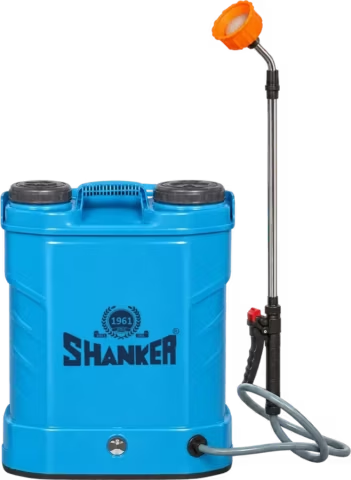
SHANKER battery knapsacks are rated at 448 to 480 litres of spray on one full charge 89. At 200 litres an acre, that is a little over 2 acres per charge.
Which SHANKER Sprayer for Chilli, Onion and Gram
| Job | SHANKER sprayer | Why |
|---|---|---|
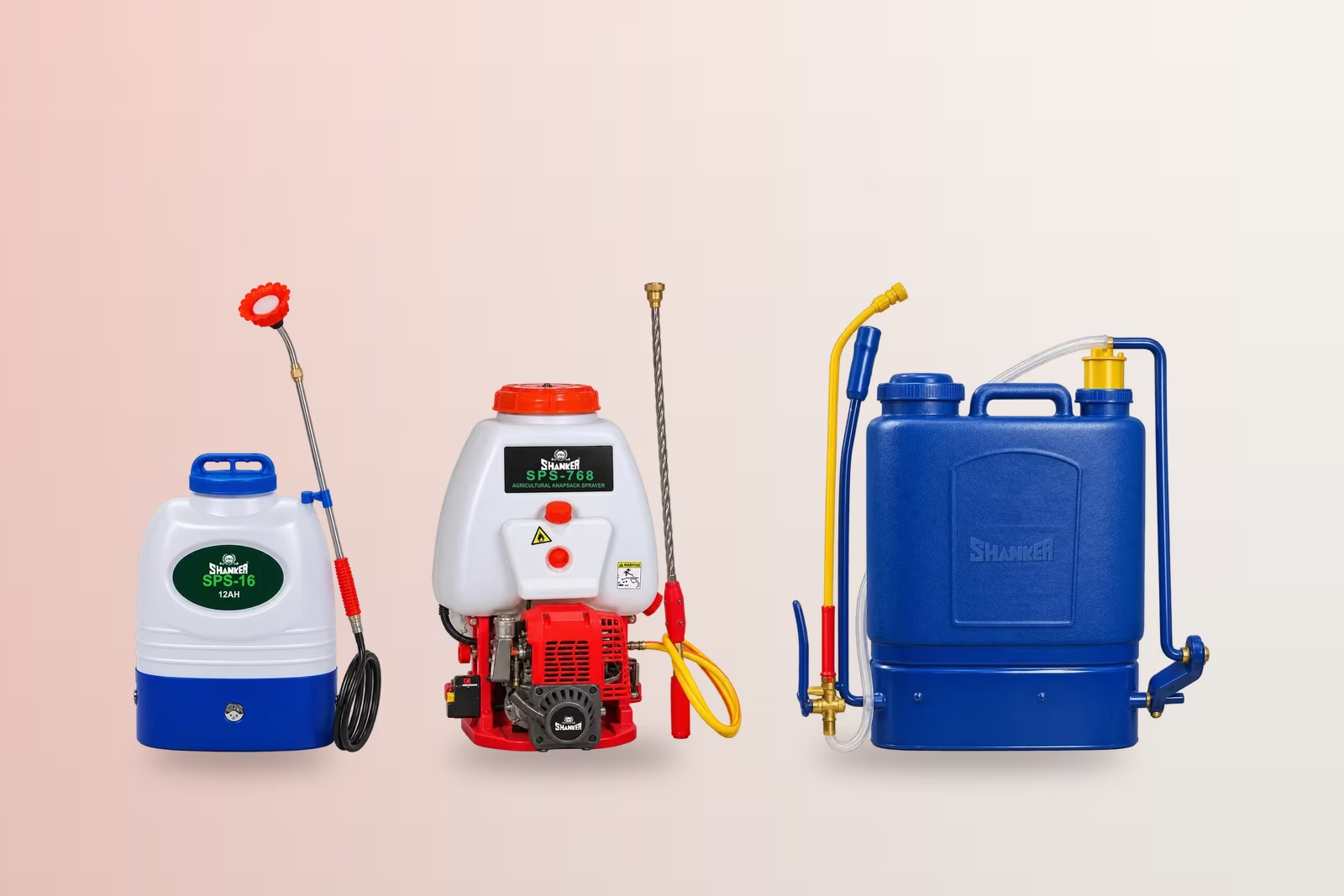
| Chilli, onion and gram on small and mid-size plots | Battery knapsack: Ganesh SHP-12 and its 16 L sister models | Its product page names "soybean, wheat, gram, onion, chilli and vegetables on small and mid-size plots" 8 |
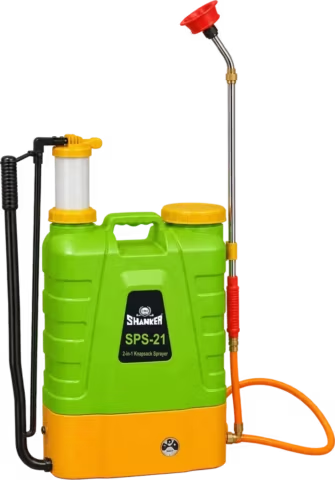
| Gram far from a charging point | 2 in 1 battery and hand lever: Nandi SPS-21 | Its page says: "Choose it for long days away from power on soybean, wheat and gram" 9 |
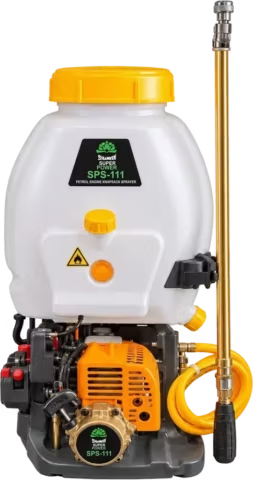
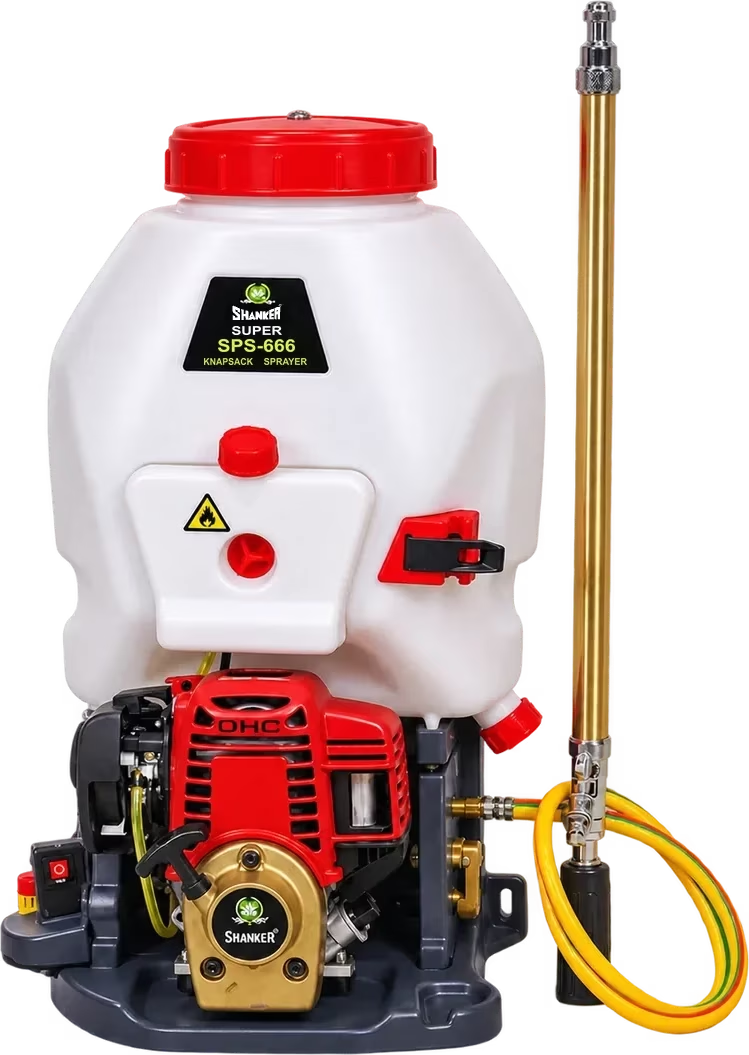
| Tall chilli rows | Petrol knapsack: Super Power SPS-111 | Its page says "It suits cotton, chilli, pomegranate rows" and lists a 3 feet spray gun with three nozzles 10 |
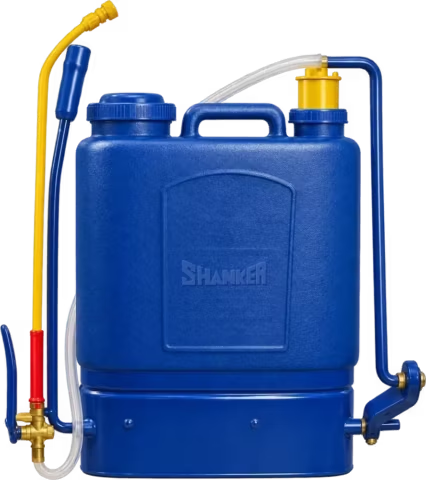
| Small plots and nurseries, no battery or fuel | Manual knapsack: SRP-4 | Its page says it suits "small plots, nurseries" 11. The IPM packages give 15 to 20 strokes a minute with a hollow cone nozzle on a lever sprayer 123 |
The SHP-12 comes with a "Flower Type multi Hole nozzle with 4 holes and fan flat type nozzle" 8. Keep the flat fan for weedicide. For the full comparison of power types, read battery, petrol or HTP sprayer.
Label and Safety Rules
These rules apply to every spray on chilli, onion and gram.
- Use only approved products. For chilli thrips, the government advice is: "Use only CIB & RC approved label claim insecticides" 5. A label claim means the product is approved for that pest on that crop.
- Check the crop on the label. The Central Insecticides Board and Registration Committee (CIB&RC) publishes "Major Uses of Pesticides" lists for insecticides, fungicides, herbicides and bio-pesticides, updated to 30.09.2026 6. Your KVK or agriculture office can check a product for you.
- Read the label and follow it. PAU: "Read carefully instructions given on pesticide label and follow the same" 4. PAU also advises: "obtain bill from the shopkeeper" 4.
- Do not cut the dose or mix products on your own. For chilli thrips the advice is "target specific insecticides (only if necessary) instead of insecticide mixtures" 5.
- Change the product group. The chilli package says to "Avoid the repeated use of the same insecticide" and to "rotate/alternate insecticide classes and modes of action" 1.
- Respect the waiting period. No spray in the 7 days before harvest, as the packages state, and longer if the label says so 1235.
- Keep weedicide apart. "Do not use same sprayer for weedicide and insecticide" 3.
- Watch the weather. "Do not apply on hot sunny day or strong windy condition", "Do not apply just before the rains and also after the rains" and "Do not apply against the wind direction" 3.
- Fix leaks first. "Do not use leaky, defective equipment" 3.
- Wear the kit and wash up after. Our safe spraying guide covers the label colours, gloves, mask and storage.
When a pest is new to you, or nothing seems to work, take a sample to your nearest KVK before you buy anything.
FAQ
Yes, for insect and disease sprays, if you wash it well between crops. Do not use the same sprayer for weedicide; the government packages say "Do not use same sprayer for weedicide and insecticide" 3.
At the 200 litres an acre in most entries of the chilli package, a 16 L tank is about 12 to 13 fills and a 20 L tank about 10 1. Calibrate your own sprayer, because walking speed and nozzle wear change the figure.
No. The package says "Do not apply pesticides during preceding 7 days before harvest" 1, and some product labels give a longer waiting period 5. Read the label before you spray.
Keep this chilli spraying guide with your sprayer, and send us your crop and acreage on WhatsApp at +91 9752223519 if you want help picking a machine.
Sources
- Directorate of Plant Protection, Quarantine and Storage and NIPHM, AESA based IPM Package No. 24, Chillies/Capsicum (2014): niphm.gov.in Back to Text
- Directorate of Plant Protection, Quarantine and Storage and NIPHM, AESA based IPM Package, Onion (2014): niphm.gov.in Back to Text
- Directorate of Plant Protection, Quarantine and Storage, NIPHM and NCIPM, Integrated Pest Management Package for Chickpea (2014): niphm.gov.in Back to Text
- Punjab Agricultural University, Package of Practices for Crops of Punjab, Rabi 2025-26, Gram "Plant Protection" and chapter 11 "Spray technology": pau.edu Back to Text
- Directorate of Plant Protection, Quarantine and Storage, Technical Booklet IPM-01/2022, Management strategies for invasive thrips (Thrips parvispinus) in chilli (ad-hoc): ppqs.gov.in Back to Text
- Central Insecticides Board and Registration Committee, Major Uses of Pesticides, lists as on 30.09.2026: ppqs.gov.in Back to Text
- Soumia P S, Karuppaiah V and Major Singh, ICAR Directorate of Onion and Garlic Research, "Integrated management of pests on onion and garlic", Indian Horticulture 62(6), 2017, abstract: epubs.icar.org.in Back to Text
- United Agro Equipment, SHANKER Ganesh SHP-12 battery knapsack sprayer product page: unitedagroequipment.com Back to Text
- United Agro Equipment, SHANKER Nandi SPS-21 battery and manual 2 in 1 knapsack sprayer product page: unitedagroequipment.com Back to Text
- United Agro Equipment, SHANKER Super Power SPS-111 petrol knapsack sprayer product page: unitedagroequipment.com Back to Text
- United Agro Equipment, SHANKER SRP-4 manual knapsack sprayer product page: unitedagroequipment.com Back to Text