

Short answer: Cotton spraying at boll stage pays only when pink bollworm crosses the threshold: 10% damaged flowers, 10% damaged green bolls, or 8 moths a trap for 3 days. Use 150 to 200 litres of water per acre, a cone nozzle, and aim at the middle and lower canopy.
At boll stage the cotton crop is tall and thick, and the bolls that pay for the season sit inside the canopy. Pink bollworm larvae live inside those bolls1. A spray that only wets the top leaves does little for them. This guide brings together what ICAR's Central Institute for Cotton Research (CICR), Nagpur, and Punjab Agricultural University (PAU) say about when to spray, how much water to use and which sprayer reaches the target.
First, Check Whether You Need to Spray
CICR's advisory sets the economic threshold level (ETL) for pink bollworm in three ways1:
- Flowers: "10% damaged flowers (Rosette flowers)"
- Green bolls: "10% damaged green bolls (at least two bolls out of 20 bolls having white or pink larvae/ exit holes)"
- Traps: "8 moths catch per pheromone trap for consecutive 3 days"
To check bolls, CICR advises "plucking and dissecting 20 green bolls per acre from different plants randomly"1. Its advice is that "On crossing ETL spraying of recommended insecticides is advocated"1. Below the threshold, keep scouting and keep removing rosette flowers by hand.
For sucking pests CICR gives these thresholds, based on a sample of 20 plants per acre1:
- Jassid: 2 nymphs per leaf
- Thrips: 10 thrips per leaf
- Whitefly: 6 whitefly per leaf
Rules CICR Asks Every Cotton Farmer to Follow
These come straight from the institute's 2024-25 advisory and its 2026 illustrated guide12:
- "Advised to use only label claim insecticides for pest control."
- "Never use tank mixtures of any agrochemicals along with insecticides."
- "Strictly avoid spraying pyrethroids before 120 days of sowing or any insecticide mixtures at any time to prevent whitefly/aphid outbreaks."
- "Do not repeat same insecticide more than twice."
- "Use protective aids while handling chemical pesticides."
PAU adds one practical point: "Repeat the spray immediately if it rains with in 24 hours after spray"3.
How Much Water per Acre for Cotton Spraying
CICR's advisory says: "Use 150-200 litres of water /acre or 375-500 litre/ ha for dilution of the insecticides"1.
PAU gives figures by sprayer type. Insecticides for sucking pests, bollworms and tobacco caterpillar "should be sprayed using 125-150 litres spray material per acre with the manually operated knapsack sprayer or 75 litres with the shoulder-mounted power sprayer"3. PAU adds that the "actual amount of insecticide recommended should not be reduced" when the water changes3.
With a 20 L tank, 150 litres per acre is 7 to 8 tank fills. Calibrate your own sprayer to confirm the number before you mix.
Cotton Spraying: Getting Spray Into the Canopy
Make walking paths. PAU's tip: "Making pathways by pressing the branches on both sides helps in efficient spraying. Make such pathways at 2 meters distance for the manually operated knapsack sprayer and at 4 meters for the shoulder-mounted power sprayer"3.
Aim low and under. CICR's 2026 guide, writing on boll rot, says nozzles should be "directed into the middle and lower thirds of the canopy" because sprays "may be ineffective" if they "only coat the top leaves"2. For whitefly it advises: "Direct sprays to hit the undersides of the leaves where whiteflies live and feed"2.
Use the right nozzle. For insects and diseases, PAU advises "cone type nozzle"4. The national IPM package gives "Hollow cone nozzle @ 35 to 40 psi" for a lever knapsack5.
On the Day of Cotton Spraying
The government IPM package for cotton lists a few simple checks for spray day5:
- "Do not apply on hot sunny day or strong windy condition."
- "Do not apply just before the rains and also after the rains."
- "Do not apply against the wind direction."
- "Do not use leaky, defective equipment."
- "Do not use same sprayer for weedicide and insecticide."
Before you mix, walk the sprayer on plain water for a minute. Check the tank cap, hose joints and gun for leaks, and look at the spray pattern.
Knapsack or Power Sprayer for Cotton Spraying?
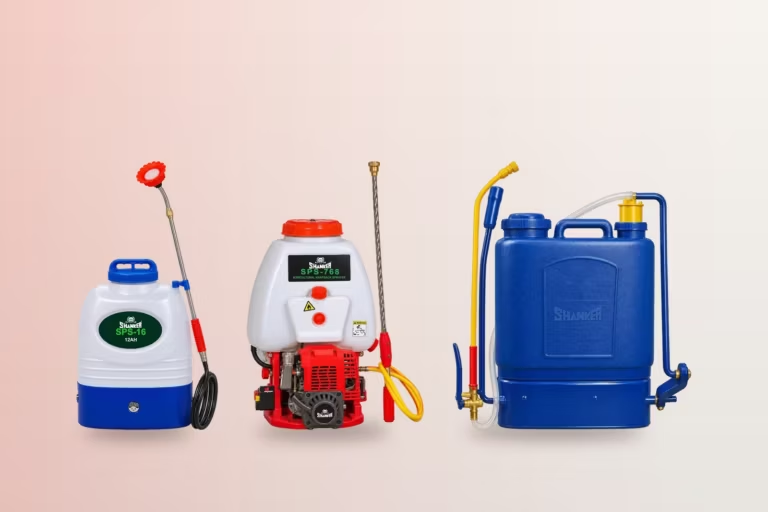
The government IPM package for cotton advises: "Knapsack sprayer in the early stage of crop growth" and "Power sprayer to be used during the later stages of crop growth"5.
That matches the SHANKER range:
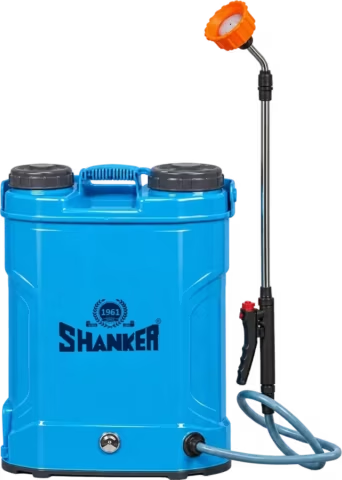
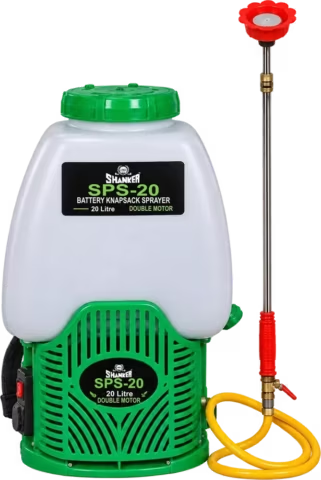
- Early season: a battery knapsack such as Mahadev SHP-21 or SPS-20 (20 L, double motor, 110 PSI double diaphragm pump)6.
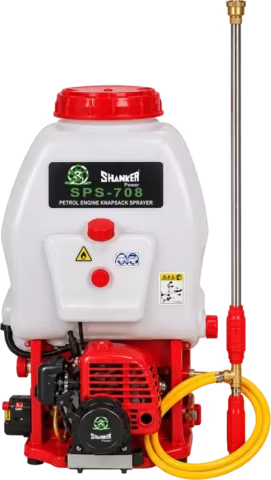
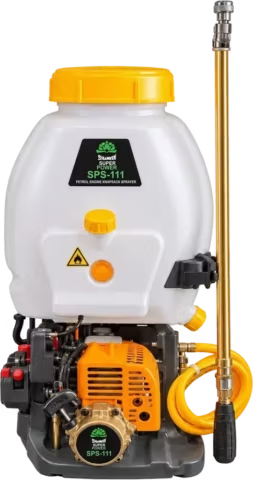
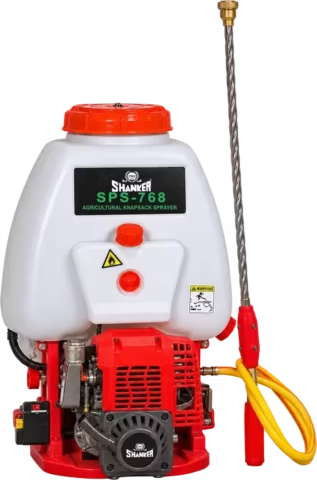
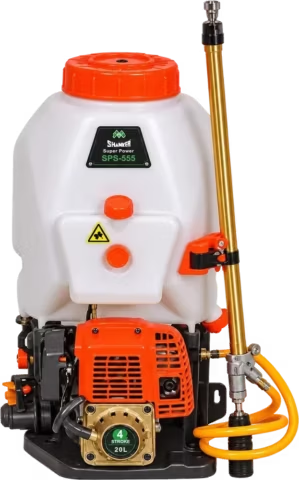
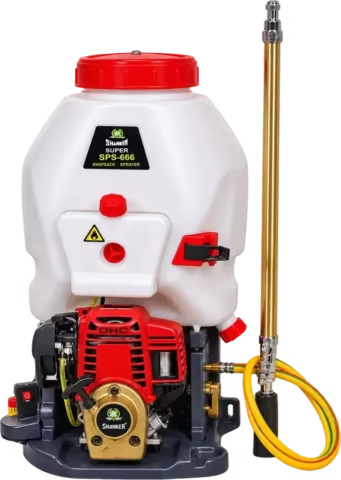
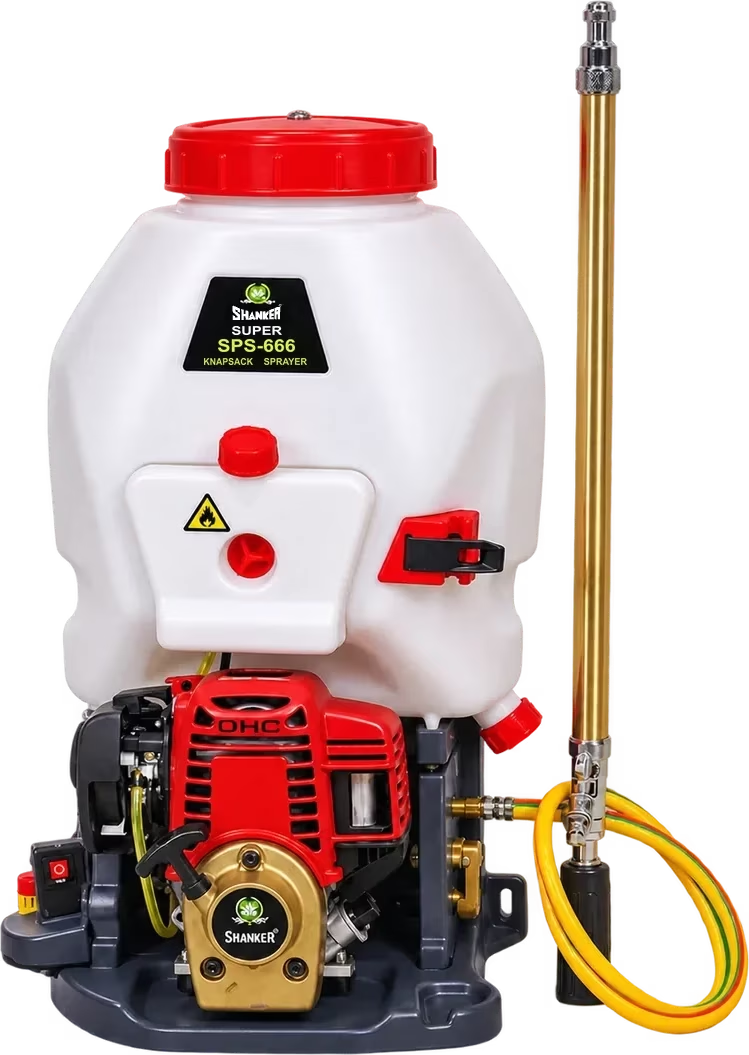
- Boll stage, tall crop: a petrol knapsack. SPS-708 and SPS-111 (2 stroke, 26 cc), SPS-768 and SPS-555 (4 stroke, 31 cc) and SPS-666 (4 stroke, 35 cc GX-35) all have a brass pump cylinder, a working pressure of 30 to 35 kgf/cm², a pump flow of 10.5 litres per minute and a 3 feet spray gun6.
Keep Herbicide Away from Cotton
PAU warns: "Cotton is highly sensitive to the 2, 4-D herbicide" and when the ester form is sprayed on maize next to cotton, "its vapours cause serious injury to the cotton crop"3. After using 2,4-D, PAU advises filling all spraying equipment, tubs and buckets with 0.5 per cent washing soda solution "in the evening. Next morning, flush all equipments thoroughly with fresh water"3. Better still, keep a separate sprayer for herbicides.
End of Season
CICR advises: "Do not extend cotton crop beyond 180 days" and to clean up "residual stalks and partially opened bolls from fields"1. After the last spray, wash the sprayer, drain it fully and service the pump before storage.
FAQ
CICR's advice is to spray when the pest crosses ETL, not on a fixed calendar1. Scout first.
For the early crop, yes. For a tall crop at boll stage, the government IPM package advises a power sprayer5.
CICR says: "Never use tank mixtures of any agrochemicals along with insecticides"1.
Sources
- ICAR Central Institute for Cotton Research, Nagpur, "Strategies and Advisory for Cotton Pest and Disease Management for the year 2024-25": nsai.co.in Back to Text
- Nagrare V.S. and others (2026), "An Illustrative Guide for Integrated Management of Cotton Pests, Diseases and Nematodes", ICAR Central Institute for Cotton Research, Nagpur: cicr.org.in Back to Text
- Punjab Agricultural University, Package of Practices for Kharif Crops of Punjab, Kharif 2026, Cotton, "Spray Technology" and "Precautions": pau.edu Back to Text
- Punjab Agricultural University, Package of Practices for Crops of Punjab, Rabi 2025-26, chapter 11 "Spray technology": pau.edu Back to Text
- Directorate of Plant Protection, Quarantine and Storage and NIPHM, Integrated Pest Management Package for Cotton (2014): niphm.gov.in Back to Text
- SHANKER product brochure (2022), battery and petrol knapsack sprayer pages. Back to Text