

Short answer: A soybean spraying calendar has two weed sprays, within 2 days of sowing and at 15 to 20 days, and then only the insect and disease sprays your weekly field check calls for. Use a flat fan nozzle for weedicide and a hollow cone for insects and diseases.
On a soybean farm the sprayer comes out several times a season: for weeds at sowing and again a fortnight later, then for caterpillars, beetles and leaf diseases. Not every one of those sprays is needed. This soybean spraying calendar uses published government and university guidance to show when a spray earns its cost, and what to fit on the sprayer for each job.
The soybean harvest is now in. This is the right time to plan next season and to check your sprayer before it goes into storage.
Stage 1: At Sowing (Pre-Emergence Weed Control)
Pre-emergence herbicides go on the soil before weeds come up. Punjab Agricultural University's soybean section gives a pre-emergence spray "within 2 days of sowing using 200 litres of water per acre"1.
Soil moisture matters. The national IPM package for soybean says pre-emergence and soil-incorporated herbicides "should not be applied in dry soils"2.
Nozzle: PAU advises "flat fan or flood jet nozzles" for pre-emergence herbicides at sowing3.
Stage 2: 15 to 20 Days After Sowing (Post-Emergence Weed Control)
This is the most common soybean spray in MP. PAU gives a post-emergence herbicide spray "at 15-20 days after sowing using 150 litres of water per acre"1. The national IPM package also lists post-emergence options at 15 to 20 days after sowing2.
Nozzle: flat fan. PAU: "Always use flat fan nozzles for spraying post emergence herbicides"3. The IPM package gives the lever sprayer setting for weeds as a flat fan or flood jet nozzle "@ 15 to 20 psi" with "7 to 10 strokes/min"2.
Which herbicide to use is a question for the label and your local KVK. Ask them for the current list of herbicides recommended for soybean in your district.
Sprayer tip: keep one sprayer, or at least one well-washed tank, for herbicides. The IPM packages advise: "Do not use same sprayer for weedicide and insecticide"4.
Stage 3: Seedling to Flowering (Scout Before You Spray)
From germination onward, walk the field every week. The IPM package recommends field observation "weekly in the morning preferably before 9 a.m."2. It sets economic threshold levels, the pest counts at which a spray is justified. Below these, spraying usually costs more than it saves.
Thresholds from the national IPM package for soybean, per metre of row2:
- Blue beetle: 4 beetles at seedling stage
- Green semilooper: 2 larvae at flowering
- Tobacco caterpillar (Spodoptera): 4 larvae at flowering
- Girdle beetle: 10% infestation at flowering
- Helicoverpa (pod borer): 3 larvae at podding
The package is clear: "Application of pesticides should only be resorted if pest population crosses the economic threshold levels"2.
Stage 4: Flowering and Pod Fill (Insect and Disease Sprays)
When a threshold is crossed, a well-timed spray matters more than a strong one.
- Time of day: for Spodoptera, the package advises: "Spray operation should be carried out either in morning or late evening hours, as during day time larvae of Spodoptera hide in the soil crevices"2.
- Rain: "Do not spray if there is forecast of heavy rains in next 1-2 days"2.
- Coverage: "Spray pesticides thoroughly to treat the undersurface of the leaves, particularly for mites, whiteflies, Spodoptera etc."2.
- Do not repeat: the same insecticide "should not be repeated for second spray"2.
Nozzle: a hollow cone nozzle for insects and diseases. The package gives "Hollow cone nozzle @ 35 to 40 psi" and "15 to 20 strokes/min" for a lever knapsack2. PAU: "Use cone type nozzle for the control of insect-pests and diseases"3.
Water: PAU's general figures are "200 litres of water for control of diseases and 100-150 litres of water per acre for control of insect pests"3. Calibrate your sprayer to know how many tank fills that is.
Stage 5: Near Harvest
The IPM package says: "Do not apply pesticides during preceding 7 days before harvest"2. Once the crop is cut, clean the sprayer fully before storing it.
Which SHANKER Sprayer Fits the Soybean Spraying Calendar
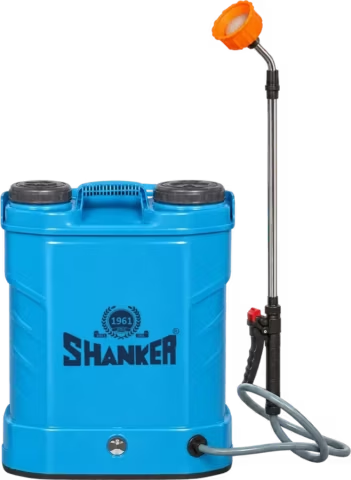
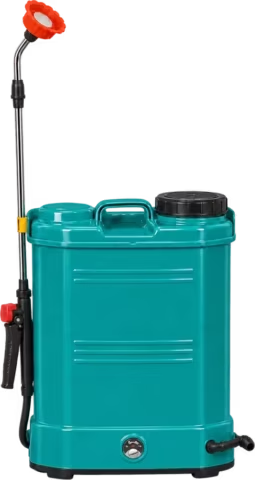
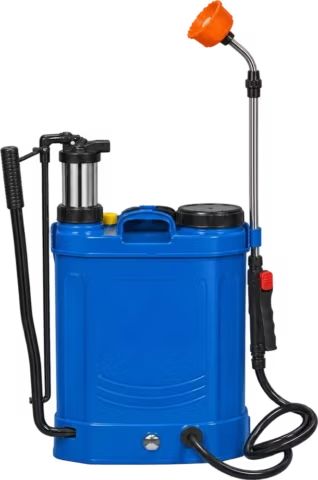
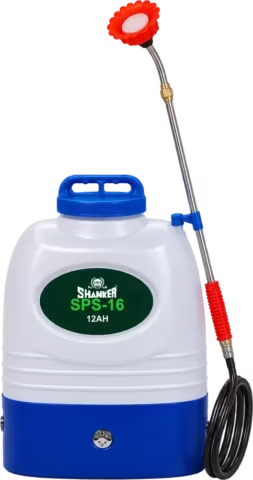
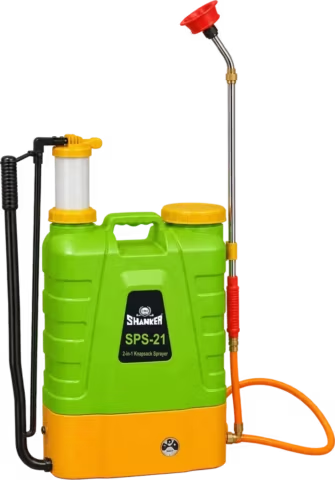
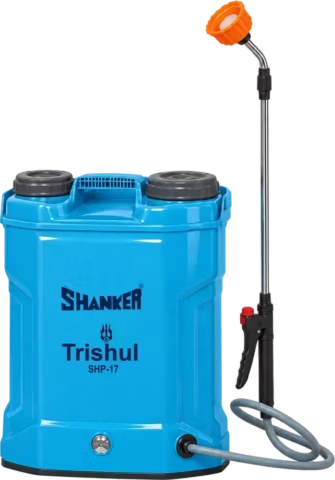
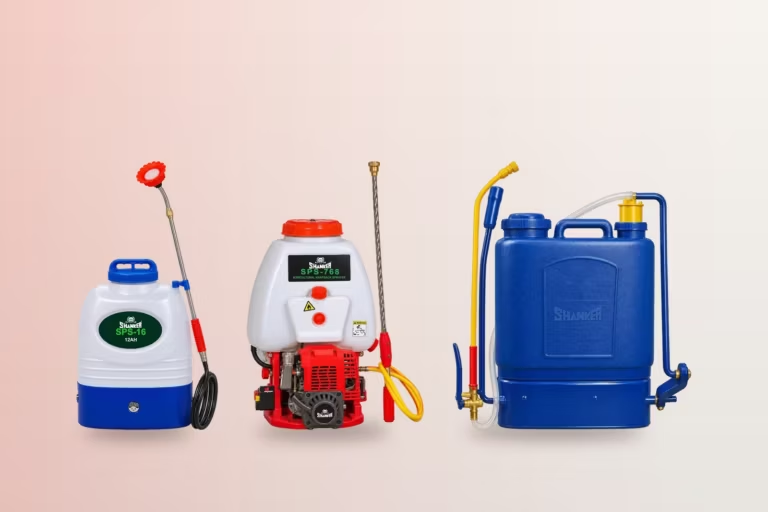
Soybean is a low crop, so a battery knapsack covers it well. Ganesh SHP-12, Trishul SHP-17, Kartikeya SHP-19 and SPS-16 have 16 L tanks and come with both a four-hole flower nozzle and a flat fan nozzle, so one machine handles weed and pest sprays once it is washed between them5. For long days far from a charging point, the 2 in 1 Parvati SHP-18 and Nandi SPS-21 can be pumped by hand when the battery runs down5.
Soybean Spraying Calendar: Season Checklist
- Calibrate before the first spray of the season
- Fit flat fan for herbicides, hollow cone for insects and diseases
- Scout weekly and spray only above threshold
- Spray early morning or late evening for caterpillars
- Wear gloves and a mask while mixing and spraying
- Wash the sprayer after every use and keep a separate one for herbicides
FAQ
Follow the label. The IPM packages advise against tank mixing different pesticides4.
At PAU's 150 litres per acre for a post-emergence herbicide, about 9 to 10 tank fills1. Calibrate to get your own number.
It carries more per trip. For a low crop like soybean, a 16 L single motor model also does the job. Choose by how far you walk between refills.
Sources
- Punjab Agricultural University, Package of Practices for Kharif Crops of Punjab, Kharif 2026, Soybean section, "Weed Control": pau.edu Back to Text
- Directorate of Plant Protection, Quarantine and Storage, NCIPM and NIPHM, Government of India, Integrated Pest Management Package for Soybean (2014), sections 3.6 "Chemical Control", the AESA advisory table, the application protocol and "Do's and don'ts in IPM": niphm.gov.in Back to Text
- Punjab Agricultural University, Package of Practices for Crops of Punjab, Rabi 2025-26, chapter 11 "Spray technology": pau.edu Back to Text
- NIPHM, AESA based IPM: Chillies/Capsicum, "Equipment" and "Precautions for applying pesticides": niphm.gov.in Back to Text
- SHANKER product brochure (2022), battery knapsack sprayer pages. Back to Text