
Short answer: The right sprayer nozzle depends on the job: hollow cone at 35 to 40 psi for insects and diseases, flat fan at 15 to 20 psi for weedicide, and flood jet or flat fan for pre-emergence weedicide. Replace a nozzle when its flow rises 10% above new.
Two sprayers can carry the same chemical at the same dose and give very different results because of one small part at the end of the lance. Scientists at the ICAR Directorate of Weed Research in Jabalpur write that nozzles "break the liquid into droplets, form the spray pattern, and propel the droplets in the proper direction" and "determine the amount of spray volume at a given operating pressure, travel speed, and spacing"1.
This guide covers the three nozzle types most farmers in central India use, what each is for, and how to look after them.
The Short Answer
Punjab Agricultural University (PAU) puts the rule in three lines2:
- "For spray of pre-emergence herbicides at the time of sowing, use flat fan or flood jet nozzles."
- "Always use flat fan nozzles for spraying post emergence herbicides."
- "Use cone type nozzle for the control of insect-pests and diseases."
The government's IPM packages give the same split and add working pressures for a lever knapsack3:
- Insects and diseases: "Hollow cone nozzle @ 35 to 40 psi"
- Weeds: "Flat fan or flood jet nozzle @ 15 to 20 psi"
Hollow Cone Nozzle: For Insects and Diseases
A hollow cone nozzle throws its spray in the shape of a cone. PAU and the IPM packages recommend it for insecticides and fungicides23. These sprays have to reach the undersides of leaves and the inside of the crop. The IPM package for soybean advises spraying "thoroughly to treat the undersurface of the leaves, particularly for mites, whiteflies, Spodoptera etc."3.
Droplet size is a trade-off. Tamil Nadu Agricultural University lists fine droplets as giving "More under leaf coverage" and "Good penetration into the crop", but also "More loss due to wind, thermal current". Coarse droplets give "Less loss due to wind" but "Poor penetration into the crop"4. Pressure moves you along that scale: the DWR scientists note that "increasing the spray liquid pressure with most nozzle designs" results in "a finer spray"1. Run a cone nozzle at the recommended 35 to 40 psi on a lever sprayer, and do not spray insecticide in wind.
Flat Fan Nozzle: For Weedicides
A flat fan nozzle sprays a flat, fan-shaped sheet. The DWR scientists list the standard flat fan as the "Main nozzle used in broad-scale spraying" of herbicides, at 200 to 400 kPa1.
For an even result, passes must overlap. The same article states: "a proper spray overlap of 30 % in flat fan nozzle and 50 % in flood jet nozzle is essential" for uniform spray1.
Flood Jet Nozzle: For Pre-Emergence and High Volume
A flood jet nozzle gives a coarse spray at low pressure. The DWR table lists the flooding flat fan for "High volume pre-emergence herbicides", with "Large droplets result in less drift"1. PAU allows flat fan or flood jet for pre-emergence and flat fan only for post-emergence herbicides on wheat5.
Droplet Size and Drift
Spray drift is chemical that lands where you did not aim it: on your own crop, a neighbour's field, a water source or a person. The DWR article lists the causes as "Wind speed and direction, temperature and relative humidity", the spray mix and "Nozzle type and size, operating pressure, and the height of the spray boom"1. It adds that droplets smaller than 150 microns "are more prone to be getting drifted"1.
Its drift control tips include: "Increase the droplet size by reducing the pressure", use "nozzles that produce larger droplets", and lower the boom height1. On a knapsack, that means holding the lance lower and steady rather than waving it high.
The weather advice from Indian institutes is consistent:
- PAU: "Never spray accross the direction of the wind flow. Spray should be done on calm days"2.
- IPM package: "Do not apply in hot or windy conditions"3.
What Comes with SHANKER Sprayers
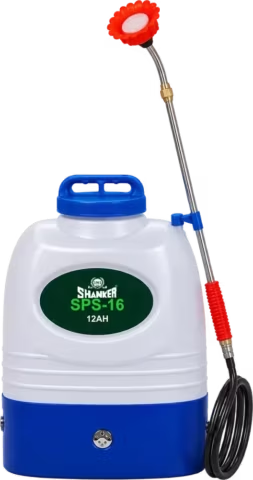
- Battery sprayers: Ganesh SHP-12, Trishul SHP-17, Kartikeya SHP-19, SPS-16 and Mahadev SHP-21 come with a "Flower Type multi Hole nozzle with 4 holes and fan flat type nozzle"6. Fit the flat fan for weedicide and the multi-hole nozzle for other sprays.
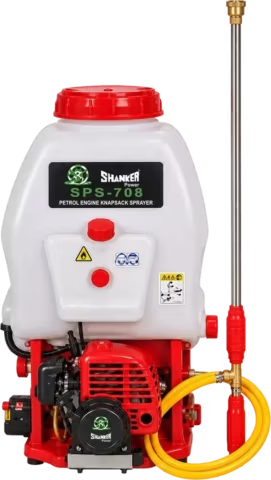
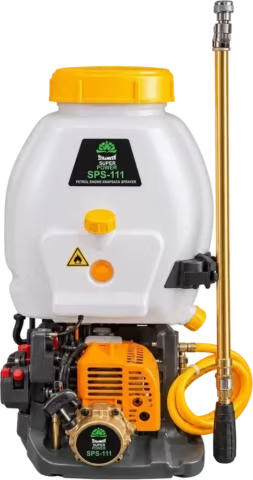
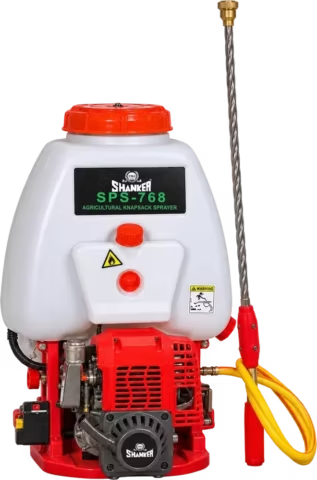
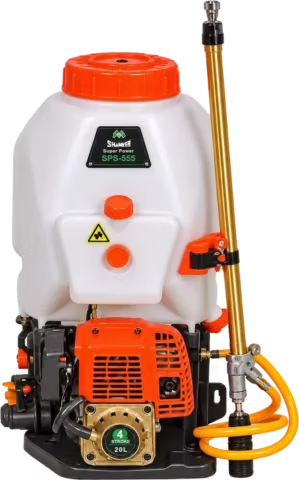
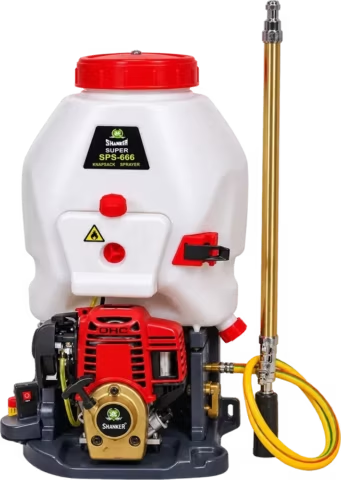
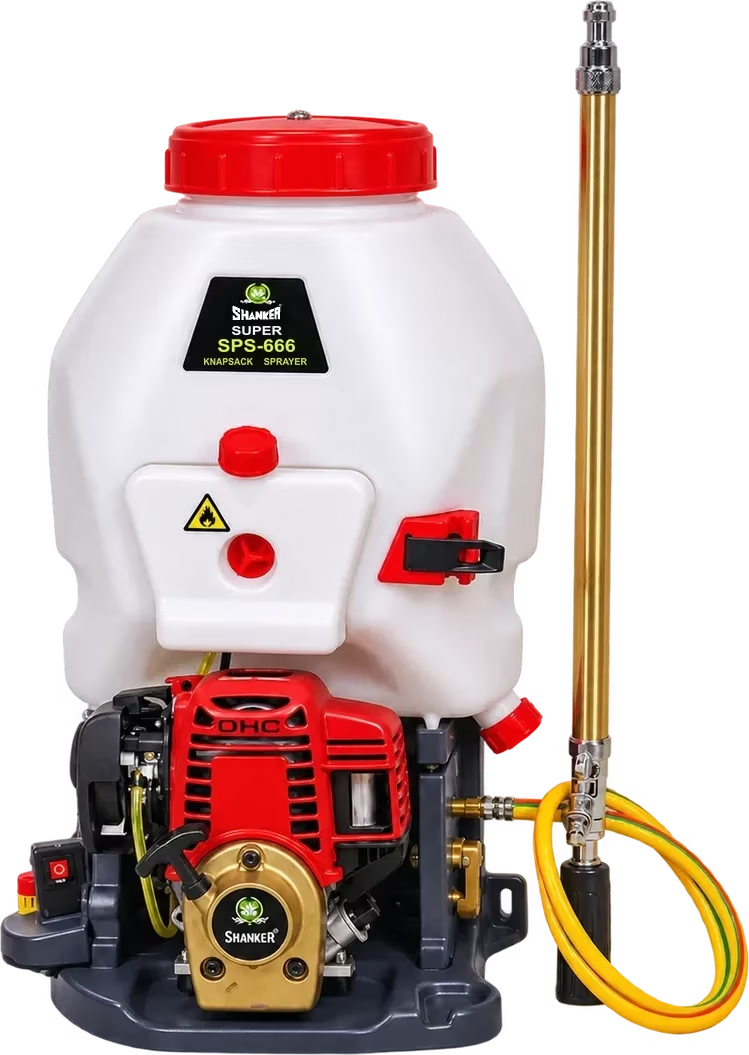
- Petrol knapsack sprayers: SPS-708, SPS-111, SPS-768, SPS-555 and SPS-666 come with a 3 feet spray gun and three nozzles on a stainless steel lance6.
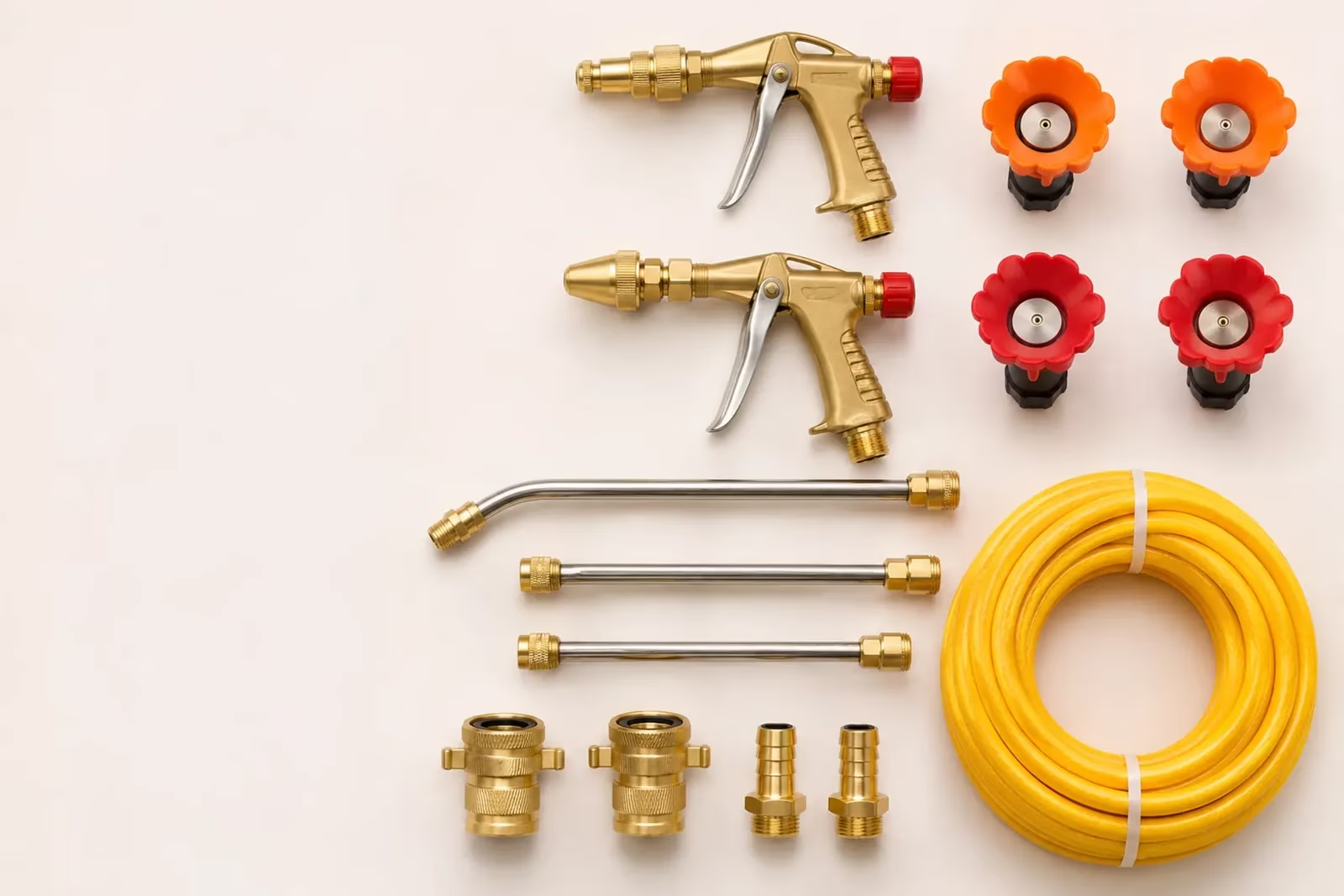
- Spares: the SHANKER battery sprayer accessories list includes an "8 Holes Nozzle", a range of nozzle heads, an adjustable brass lance, an extension rod and a three nozzle gun6. Ask your dealer to show you each one on water before you buy.
How to Tell a Sprayer Nozzle Is Worn
A worn nozzle sprays more than its rating and lays it down unevenly. The DWR article says a nozzle "should be replaced, if the flow exceeds its factory rating by 10%", and that variation in spray can reach "35 to 57%" in "worn out and damaged nozzles" against 6% for new ones1. PAU uses 10 to 15% as the limit2.
A simple test: run the sprayer on clean water, hold a jug under the nozzle for exactly one minute and measure. Record the figure for a new nozzle and compare every season.
Nozzle material matters for life. The DWR article rates ceramic and stainless steel tips well for wear and says brass tips have "Poor wear life and are susceptible to corrosion"1.
Cleaning a Blocked Nozzle
Never blow into a nozzle. The government IPM packages say: "Do not blow the nozzle with mouth for any blockages. Clean with water and a soft brush"3. PAU: "remove and disassemble the nozzle assembly. Clean the openings/filter and nozzle tips of any obstructions and reassemble"2. Use clean water for spraying to avoid blockages in the first place2.
FAQ
Not well. Use flat fan for post-emergence weedicides and a cone nozzle for insects and diseases2.
Check the overlap. The DWR article calls for 30% overlap with flat fan nozzles1. Also check nozzle height and wear.
Higher pressure gives a finer spray, and the DWR article notes that "the risk of drift tends to increase" as spray becomes finer1. Use the right nozzle and hold it closer to the target instead.
Sources
- Chethan C. R., Singh P. K., Dubey R. P., Singhariya S. and Choudhary V. K., ICAR Directorate of Weed Research, Jabalpur, "Herbicide application in agriculture: nozzle selection and effective application", Indian Farming 68(12), December 2018: epubs.icar.org.in Back to Text
- Punjab Agricultural University, Package of Practices for Crops of Punjab, Rabi 2025-26, chapter 11 "Spray technology" and "Precautions during spraying": pau.edu Back to Text
- Directorate of Plant Protection, Quarantine and Storage and NIPHM, Integrated Pest Management Package for Soybean (2014), application protocol and maintenance guidelines: niphm.gov.in Back to Text
- TNAU Agritech Portal, "Working principle of spray equipment", "Coarse droplets" and "Fine droplets": agritech.tnau.ac.in Back to Text
- Punjab Agricultural University, Rabi 2025-26, Wheat, weed control notes: pau.edu Back to Text
- SHANKER product brochure (2022), battery and petrol knapsack sprayer pages and battery sprayer accessories page. Back to Text