
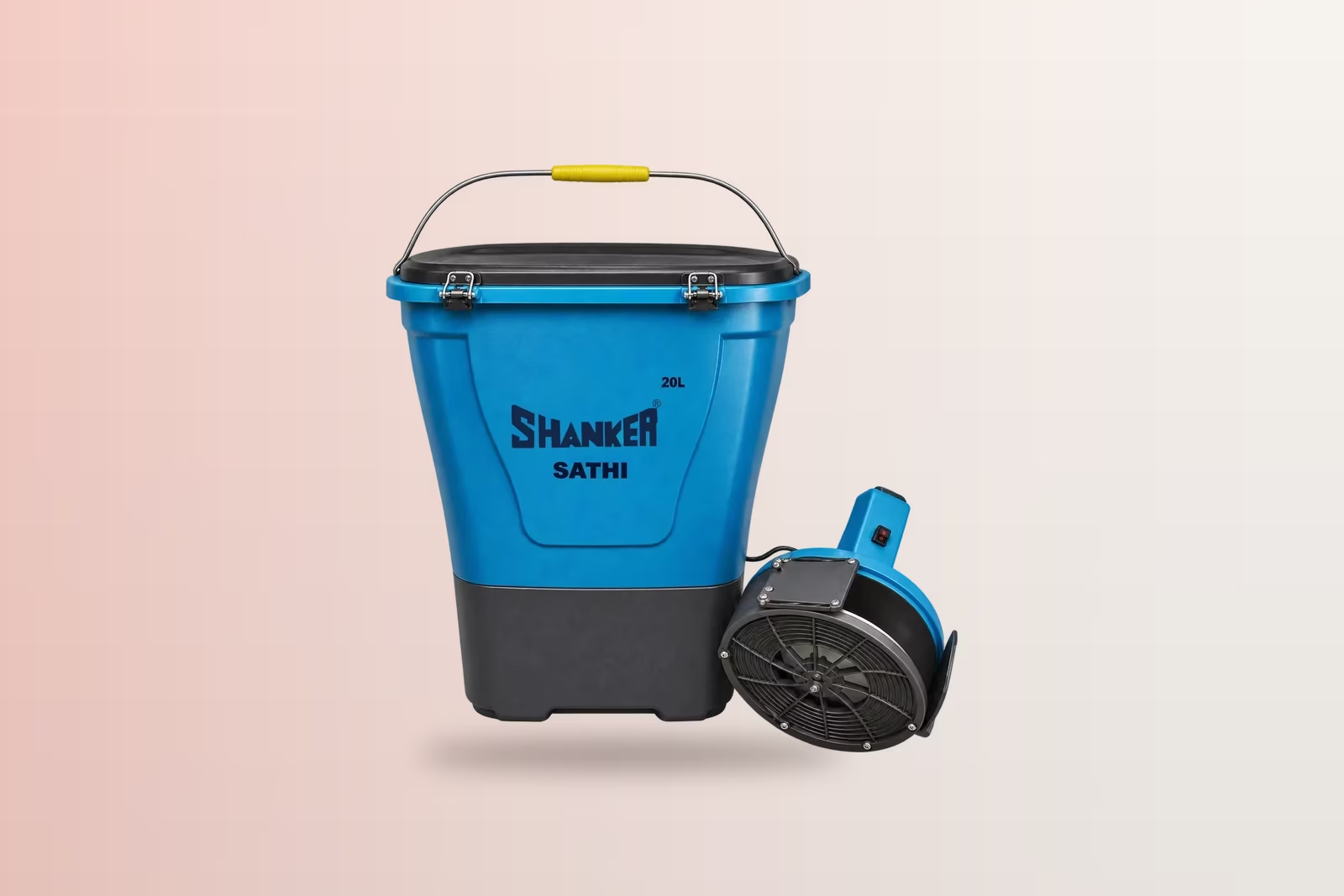
Short answer: A fertilizer broadcaster machine throws dry granules such as urea off a spinning disc, so one person walking a field can spread more evenly than by hand. Do a weighed test on a measured strip first, walk at one steady pace, and take the dose from your Soil Health Card or agriculture officer, because the machine only decides how evenly it lands.
Throwing urea by hand works, but it is hard to keep even. One handful lands thick, the next lands thin, and the crop shows the stripes a few weeks later. A battery broadcaster carried on the back does the throwing for you. What it cannot do is decide how much to throw. That part is still your job.
This guide covers the SHANKER Sathi broadcaster as its product page prints it, how to set the spread and check the rate with your own scale and tape, which granules flow well, where the dose should come from, and how to clean the machine and protect yourself. For the machine we use only the SHANKER catalogue figures on our product page. For spreading and fertilizer handling we use agricultural engineering fact sheets from Ohio State University, a fertilizer industry paper and a urea safety data sheet.
What the SHANKER Sathi Fertilizer Broadcaster Machine Is
The SHANKER Sathi is "a battery fertilizer broadcaster carried on the back" 1. Its product page prints these figures, "As Printed in the SHANKER Catalogue" 1:
| Item | Sathi, as printed |
|---|---|
| Type | Battery Fertilizer Broadcaster |
| Tank | 20 L |
| Battery | 12V 8 / 12Ah |
| Rotating speed | 3000 (Adjustable) |
| Working range | 10 Meters |
| Charger | Three stage reliable & durable charger |
The page lists the battery as "Maintenance free big sized powerful battery: 12V/8Ah. & 12V/12Ah." 1. The catalogue prints the rotating speed as "3000 (Adjustable)" and does not print a unit after the number 1.
What it is for, in the page's own words: "It replaces hand throwing of granular fertilizer and seed on small and mid-size farms. You walk a straight line and the spinner throws to a working range of 10 metres." 1. The page adds that "It suits urea top dressing in wheat and paddy, broadcasting DAP before sowing, and spreading small seed such as berseem or mustard." 1.
What it is not for: liquid. The FAQ says it spreads "Dry granular fertilizer and seed. It is not for liquid spray; use a knapsack sprayer for that." 1. The category page adds that it is "not for liquid spray or fine powder in wind" 2. For liquid feed and pesticide, look at our battery knapsack sprayers. The Sathi is the only broadcaster in the SHANKER range 1, and you can see it on the fertilizer broadcaster page.
Which Granules Flow Well, and Why Damp Urea Causes Trouble
The Sathi page gives one rule: "Use dry, free-flowing granules. Lumps block the outlet, so sieve old bags." 1. Engineering work on spinner spreaders explains why.
Granule size decides how far it flies
Ohio State University's fact sheet on fertilizer properties says "Particle size significantly impacts spread width" and that "larger particles are generally thrown further by a spreader than smaller particles" 6. Dust and fine bits do the opposite: they "may land behind the spreader" 6. So a bag with a lot of powder at the bottom will not spread like the top of the same bag.
The same sheet notes that "Urea and DAP are examples of spherically shaped fertilizers, whereas potash is irregularly shaped" 6. Round granules roll off the spinner. Irregular ones slide and behave differently. That is one reason a setting that works for urea will not automatically work for DAP or potash.
Damp urea sticks, and sticky urea spreads badly
Ohio State describes flowability as "a material's ability to flow under humid conditions" and warns: "As humidity increases, less flowable materials will stick together, making them difficult to meter and evenly apply. Poor flow increases particle segregation and reduces spread width." 6.
Urea in particular takes up water from the air once the air is humid enough. A paper given at the International Fertilizer Industry Association's 2002 technical conference in Chennai puts it this way: urea "can absorb moisture only when the relative humidity of the ambient air is for a given temperature above a specific value", and "For prilled urea this value is 70 % for a temperature of 30°C" 7. The same paper calls caking "a process by which a fertilizer loses its desirable free flowing property" 7. A humid monsoon morning in Madhya Pradesh can easily be above that line, so an open bag left in the field will not stay free-flowing for long.
Practical steps that follow from this:
- Keep bags closed until you fill the tank. Yara's urea safety data sheet says to keep the product "in a dry, cool and well-ventilated area" and to "Keep container tightly closed and sealed until ready for use" 8.
- Sieve old or lumpy bags before filling, as the Sathi page advises 1.
- Do not leave urea in the tank overnight 1.
- Check the weather. Ohio State's spreader sheet says to "Check the local forecast before spreading fertilizer to avoid exposing the fertilizer to moisture before being spread." 5.
Mixing two fertilizers in one tank
If you pour urea and potash, or urea and DAP, into the tank together, they may not stay mixed. Ohio State warns that "Blended fertilizers of varying particle sizes can segregate in the bin during operation" 5. The safer habit is to spread each one on its own and set the machine for each.
| What is in the bag | How it behaves in a broadcaster | What to do |
|---|---|---|
| Dry, free-flowing granules | Flows and spreads as the setting intends 1 6 | Use as it is |
| Lumpy or caked granules | Lumps block the outlet 1 | Sieve first 1 |
| Dust and fine powder | Lands behind the spreader, blows in wind 2 6 | Leave the dust at the bottom of the bag |
| Two fertilizers mixed | Can separate in the tank 5 | Spread each on its own |
Setting the Spread Width and Walking Speed
SHANKER prints a working range of 10 metres 1. That is how far the spinner throws. It is not the gap you should leave between your walking lines. The edges of any spread pattern are thinner than the middle, which is why the passes have to overlap. Ohio State's calibration sheet says the gap between passes "should be the same as the determined effective swath width" and that it "can change based upon the type of material being spread" 4.
Neither the SHANKER page nor any agricultural engineering source we found gives a fixed walking speed or a fixed lane gap for a backpack broadcaster like the Sathi. So we will not give you one. You find yours with a test.
What the product page tells you to do
The Sathi page lists five steps 1:
- Use dry, free-flowing granules. Lumps block the outlet, so sieve old bags.
- Test on a tarpaulin. Spread a weighed 5 kg on a marked strip and measure the width that gets an even cover.
- Walk at one pace and peg the next pass so the edges overlap.
- Adjust the speed down for narrow plots and borders, up for open fields.
- Stop before the turn so the headland does not get a double dose.
The tarpaulin test, step by step
This is a test you run yourself. It is not a factory setting.
- Lay a tarpaulin or old plastic sheet across the path you will walk, on flat ground with no wind.
- Weigh 5 kg of the fertilizer you will actually use 1.
- Set the spinner speed you plan to use and walk straight over the sheet at your normal field pace.
- Look at the sheet. Measure the width where the cover looks even, not the width of the last few grains 1.
- Use that even width as your lane gap, so each pass overlaps the thin edge of the last one 1 4.
- Repeat the test whenever you change fertilizer or seed. Ohio State says "Calibration checks should be conducted for each material applied." 4.
Walking speed
Walk at one steady pace, the same pace you used in the test 1. Ohio State lists "varying ground speed" among the things that "can impact spreader performance" 4, and a spreader maker's technician writing in Progressive Dairy says to "maintain a constant ground speed" 9. If you slow down at the end of a row or stop to talk while the spinner runs, that patch gets extra.
Spinner speed
The Sathi's spinner speed is adjustable 1. The page says to turn it down for narrow plots and borders and up for open fields 1. Ohio State's sheet explains why it matters: "Spinner disc speed is critical to maintaining uniform spread and correct swath widths." 4. If you change the speed, run the tarpaulin test again.
Wind, borders and headlands
- Wind throws light granules sideways. On large tractor spreaders, Ohio State says it is hard to keep an even rate "if wind speeds exceed 15 mph" 5, which is about 24 km per hour. A backpack machine throwing 10 metres is likely to be upset by less, so spread in calm weather, early morning or late evening.
- Near a border, a canal or the neighbour's field, turn the spinner speed down 1.
- Stop the spinner before you turn at the end of a row so the headland does not get a double dose 1.
Checking the Rate with Your Own Numbers
A broadcaster does not have a meter that tells you kg per acre. You find the rate the simple way: weigh what goes in, measure the ground it covered, and divide. Ohio State describes the same check for big machines: spread "a previously weighed amount of product" over "a known area", then "the amount delivered divided by field acreage" gives the rate 4.
How to do it
- Weigh a fixed amount into the tank, for example 10 kg. Use a shop scale, not a guess.
- Spread it at your normal pace, in lanes set at the gap from your tarpaulin test.
- Mark where the tank runs empty.
- Measure the length you walked with a tape, and multiply by the lane gap. That is the area in square metres.
- Work out kg per acre: kg used, divided by square metres covered, multiplied by 4,047. One acre is 4,046.86 square metres 12, so 4,047 is close enough.
A worked example
Say you fill 10 kg of urea, your tarpaulin test gave an even width of 8 metres, and the tank runs empty after a total walk of 125 metres down your lanes. These are example numbers; use your own.
| Step | Sum | Answer |
|---|---|---|
| Area covered | 8 m × 125 m | 1,000 square metres |
| Kg per square metre | 10 kg ÷ 1,000 | 0.01 kg |
| Kg per acre | 0.01 × 4,047 | about 40 kg per acre |
| For a 2 acre field at this rate | 40.5 × 2 | about 81 kg |
Now compare your answer with the dose on your Soil Health Card or from your agriculture officer.
- If you are putting on too much, walk a little faster and test again. With the same flow, more ground per minute means fewer granules per square metre.
- If you are putting on too little, walk a little slower and test again.
- Change one thing at a time, then weigh and measure again.
The Sathi page does not say how the outlet flow is set on the machine, or whether the spinner speed setting also changes how much falls per minute 1. Ask your dealer to show you on your own machine, and weigh again after any change.
How Much Urea? Take the Dose from Your Soil Test
We do not give fertilizer doses on this site. The right amount depends on your soil, your crop, the variety, the sowing date and how much water you have. The machine page itself says: "Ask your agriculture officer for the dose; the machine only changes how evenly it lands." 1.
Start with your Soil Health Card
The Government of India's Soil Health Card reports your soil "with respect to 12 parameters", including N, P, K and S, and "Based on this, the card will also indicate fertilizer recommendations and soil amendment required for the farm." 11. If you have a card, its recommendation for your field comes first. If you do not, ask your village agriculture officer or the nearest Krishi Vigyan Kendra about a soil test.
What a university package says, as an example
To show what an official recommendation looks like, here is wheat from Punjab Agricultural University's Package of Practices for Rabi 2025-26 10. It starts with the soil test: "Apply fertilizer on soil test basis (See Chapter on 'Soil Testing'). In the absence of a soil test, add the following amounts of fertilizers to wheat grown on medium fertile soils" 10. For the urea top dressing it says: "Broadcast 45 kg urea for timely sown crop and 35 kg per acre for wheat crop sown after mid December each with first and second irrigation." 10. It adds: "If second irrigation is delayed due to rains, the urea should be broadcasted at 55 days after sowing." 10.
That is Punjab's advice for Punjab's soils, varieties and dates. Madhya Pradesh farms differ. Use it only to see how a recommendation is written, and take your own figure from your Soil Health Card, your Krishi Vigyan Kendra or the state agriculture department. For paddy and soybean, ask them in the same way; we have not quoted a dose for those crops here.
If wheat is your crop, our wheat weedicide spraying guide covers the spraying side of the same season.
Cleaning the Broadcaster After Use
Fertilizer eats metal. The Sathi page says it plainly: "Fertilizer is corrosive. Empty the tank, brush the spinner and wipe the outlet dry after every use, and never leave urea inside overnight." 1. A spreader maker's technician gives the same warning: "fertilizer products are extremely corrosive" 9.
After every use:
- Switch off and empty the tank fully. Put leftover granules back in a bag you can close tightly 8.
- Brush the spinner and wipe the outlet dry 1. Ohio State's maintenance list includes "Remove buildup of fertilizer and lime on spinner-discs and/or blades." 5.
- If you rinse any part, keep water off the battery, switch, wiring and charge point. The Progressive Dairy article says: "Be sure to not allow water on the areas of the spreader that have electrical components and wiring if so equipped." 9.
- Let it dry fully, then store it "in a clean, dry location out of direct sunlight" 9.
- Look for rust or worn parts before the next season. Ohio State's list says to "Replace worn and bent spinner-discs and/or blades" and "Replace corroded and rusty hoppers and components." 5.
Battery and spare parts
Charge the battery the same evening with the three stage charger that came with it 1. Our battery sprayer battery care guide covers charging, storage between seasons and when to replace, and it applies to the Sathi's 12V battery too.
The Sathi page says "Switches, batteries and chargers are in battery sprayer parts" 1. That list on our spare parts page includes the 12/12AH Battery, Battery 8AH, Charger 1.7A / Charger 1.1A, Charge Jack, Power Switch (1) and Power Switch (2) 3. The list does not say which part fits which model, so send the code or a photo on WhatsApp and we confirm it fits your Sathi before you buy.
Safety: Gloves, Mask and Washing Up
Yara's safety data sheet for granular urea lists it as "Not classified" for hazards 8. It still asks for basic care, and other fertilizers in the shed may need more.
- Gloves. The data sheet says gloves "should be worn at all times when handling chemical products if a risk assessment indicates this is necessary" 8, and the spreader technician says to "wear proper eye, hand and body protection when working on or operating your fertilizer spreader" 9. Plain rubber gloves while filling and cleaning keep granules and dust off your skin.
- Mask. The data sheet says: "In case of inadequate ventilation wear respiratory protection." 8. Out in an open field the air moves. Inside a closed store, or when you pour out the dusty end of a bag, a mask makes sense.
- Eyes. If dust gets in your eyes, the data sheet says: "Rinse with plenty of running water." 8.
- Wash up. "Workers should wash hands and face before eating, drinking and smoking." 8. Wash hands, forearms and face after the job 8.
- Food. Store fertilizer away from "food and drink" 8.
For DAP, potash and any mixed product, read the bag and follow its own safety advice.
Where to Buy the SHANKER Sathi
The Sathi is "sold through SHANKER dealers, not online" 1. Prices change with the season and the district, so we do not print one here. Send your district on WhatsApp at +91 9752223519 and we reply with today's price and the nearest dealer 1. You can also see it at our showroom: 11, 45, 52 Shastri Market, Indore 452001 1.
FAQ
Yes. The Sathi page lists "urea top dressing in wheat and paddy" among its uses 1. Timing and amount come from your agriculture officer or Soil Health Card. As one example, Punjab Agricultural University's Rabi 2025-26 package tells Punjab farmers to broadcast urea "with first and second irrigation" 10. Walk straight, keep one pace and overlap the edges.
The machine does not decide that. Take the dose from your Soil Health Card, which gives "fertilizer recommendations" for your farm 11, or from your agriculture officer or Krishi Vigyan Kendra. Then use the weigh and measure test in this guide to make sure the machine puts out that amount.
The price changes with the season and the district. Ask on WhatsApp at +91 9752223519 with your district and we reply with today's price and the nearest dealer 1.
Sources
- United Agro Equipment, SHANKER Sathi Battery Fertilizer Broadcaster product page (specifications "As Printed in the SHANKER Catalogue"), read 25 Nov 2026: unitedagroequipment.com Back to Text
- United Agro Equipment, Fertilizer Broadcaster category page, read 25 Nov 2026: unitedagroequipment.com Back to Text
- United Agro Equipment, Genuine SHANKER Sprayer Spare Parts, Battery Sprayer Parts list, read 25 Nov 2026: unitedagroequipment.com Back to Text
- Ohio State University Extension, FABE-561 "Spinner-Disc Spreader Set Up and Calibration", Trey Colley, John Fulton, Dewey Mann and Kaylee Port (May 2018): ohioline.osu.edu Back to Text
- Ohio State University Extension, FABE-563 "Spinner-Disc Spreader Field Execution Manual, Part 3", Trey Colley, John Fulton, Dewey Mann and Kaylee Port (May 2018): ohioline.osu.edu Back to Text
- Ohio State University, FABE-550 "Physical Properties of Granular Fertilizers and Impact on Spreading", John Fulton and Kaylee Port, revised by John Fulton (May 2025): cfaes.osu.edu Back to Text
- International Fertilizer Industry Association, IFA Technical Conference, Chennai, 2002, "Urea Caking Problems, How to Avoid Them", Pan Orphanides: fertilizer.org Back to Text
- Yara Canada, Safety Data Sheet, Granular Urea, version 3.0 (29 March 2023): yaracanada.ca Back to Text
- Progressive Dairy (Ag Proud), "Mechanics Corner: Fertilizer spreader maintenance and calibration", Ed Skeele, Kuhn North America (31 March 2017): agproud.com Back to Text
- Punjab Agricultural University, Package of Practices for Crops of Punjab, Rabi 2025-26 (August 2025), Wheat, "Fertilizer Application": pau.edu Back to Text
- Press Information Bureau, Ministry of Agriculture and Farmers Welfare, "Celebrating a Decade of Soil Health Cards" (18 Feb 2025): pib.gov.in Back to Text
- National Institute of Standards and Technology, Handbook 44 (2024), Appendix C, General Tables of Units of Measurement: nist.gov Back to Text
Related guides: battery sprayer battery care, wheat weedicide spraying guide.