
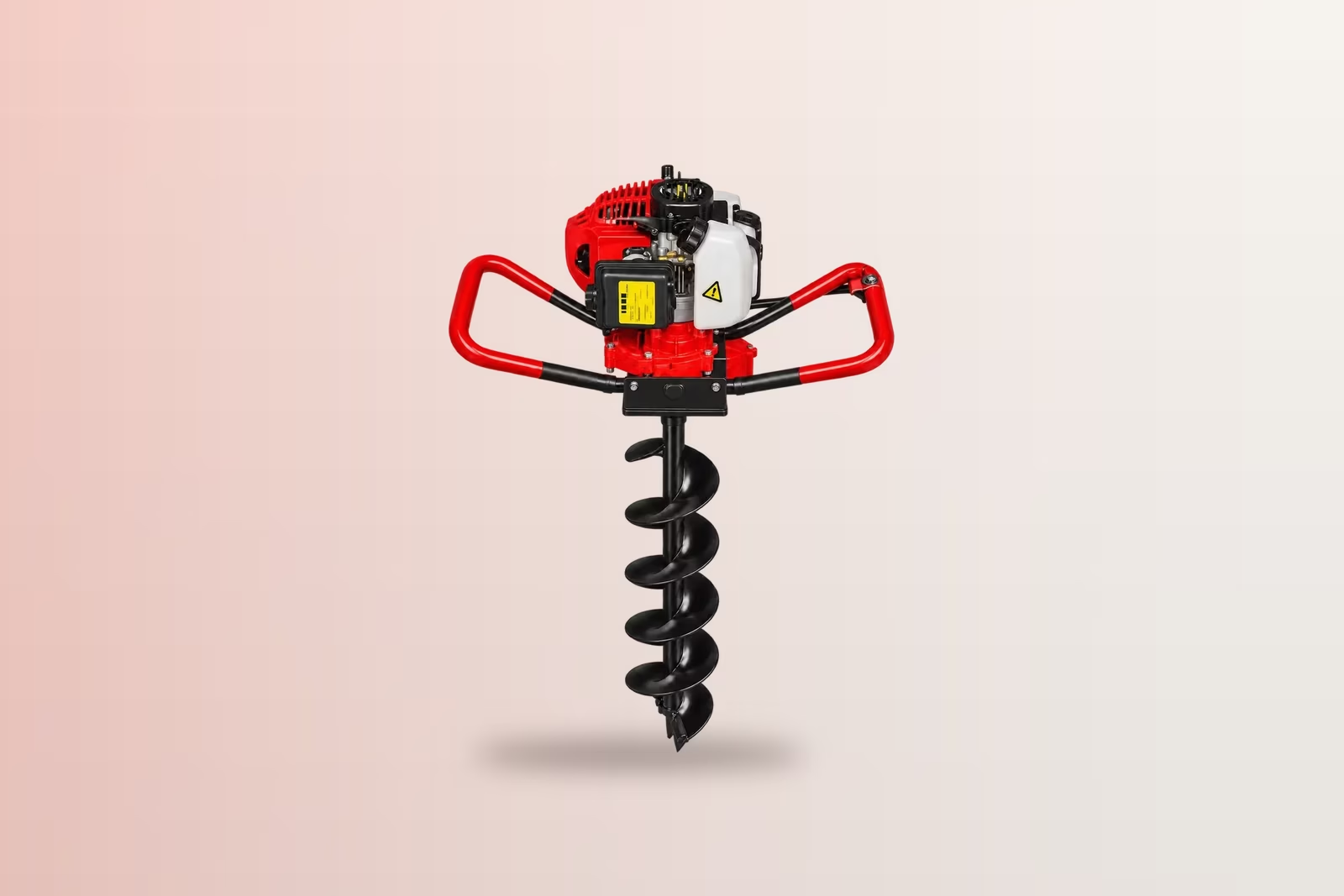
Short answer: An earth auger machine is a petrol engine that turns a spiral bit to bore round holes for saplings and fence posts, and it lifts the soil out as it digs. The pit size still comes from your horticulture advice, and the width of the bit decides whether one bore is enough or a pit needs several.
Digging is the slow part of planting an orchard or putting up a fence. Every sapling needs a pit, and every post needs a hole. A petrol auger does the boring and lifts the soil out, and you finish the pit to the size your crop needs.
This guide covers what an auger does, the pit sizes that government and university sources give for common fruit trees, what the SHANKER SPS-6500 is, how to handle hard, stony and wet ground, and the safety rules from auger makers' manuals.
What an Earth Auger Machine Does
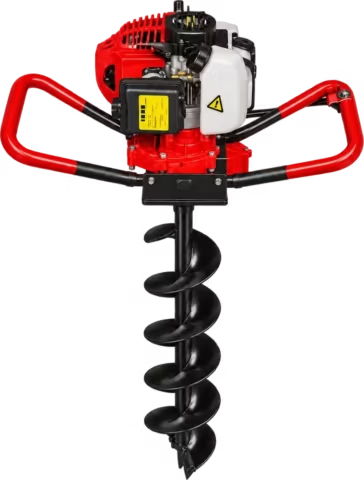
An auger has three parts: a small petrol engine, a gearbox and a spiral bit. The engine spins fast, and the gearbox slows the bit down so it has the force to cut soil. On the SHANKER SPS-6500 the engine is rated at 2.6 kW at 7500 rpm, and the auger turns at up to 300 rpm, "Geared down from the engine for torque" 1.
The bit cuts a round hole as wide as itself. The spiral carries loose soil up and out. You lift the auger every few centimetres to throw that soil clear.
Where it saves labour
We found no published time study for a hand held petrol auger. There are figures for larger machines of the same kind. The Tamil Nadu Agricultural University (TNAU) Agritech portal lists two of them:
| Machine | Hole size | Capacity | Labour | What TNAU says |
|---|---|---|---|---|
| Tractor operated post hole digger | 450 mm wide, up to 900 mm deep | 90 pits per hour | 1 operator, 1 helper | Function: "To dig holes for planting tree saplings" 11 |
| Power tiller operated auger digger | 225 mm bit, with 250, 275 and 300 mm bits as options | 25 to 30 holes per hour | Power tiller of 8 to 10 hp | "Results in 16.0 and 91.0 per cent saving in cost and time when compared to manual digging of holes" 12 |
These are bigger than a hand held earth auger machine, so do not expect the same output. They do show the kind of job an auger is built for: many holes of the same size, dug fast.
Who uses an earth auger for plantation and fencing
The SHANKER product page lists the work it is meant for: "mango, guava, teak and bamboo plantations, wire fencing, solar posts, grape and banana supports" 1. It adds that "Every pit comes out the same width, which keeps plant spacing and fence lines even" 1.
For an earth auger for fencing, the hole only needs to fit the post and its packing. For a fruit plantation, the hole is the start of a pit that your crop advice sets.
Pit Sizes for Fruit Plantation
Here is what government and university sources print. All sizes are length x width x depth.
| Crop | Pit size | Spacing printed | Source |
|---|---|---|---|
| Mango | 1 m x 1 m x 1 m | Several systems, by need | TNAU 4; Government of India IPM package for mango, reviewed by ICAR-CISH Lucknow 5 |
| Mango, deep loamy soil | 0.5 m x 0.5 m x 0.5 m | 10 x 10 m to 12 x 12 m | National Horticulture Board 6 |
| Mango, shallow or hill soil | 1 m x 1 m x 1 m | 10 x 10 m to 12 x 12 m | National Horticulture Board 6 |
| Guava | 45 cm x 45 cm x 45 cm | 5 to 6 m either way | TNAU 7 |
| Pomegranate | 60 cm x 60 cm x 60 cm | 2.5 to 3 m either way | TNAU 8 |
| Acid lime | 75 cm x 75 cm x 75 cm | 5 to 6 m | TNAU 9 |
| Sweet orange | 75 cm x 75 cm x 75 cm | 7 x 7 m | TNAU 10 |
The mango package from the Directorate of Plant Protection says: "Pits of 1m x 1mx 1m size are dug. These are exposed to sun for about 30 days" 5. The National Horticulture Board ties pit size to soil: "In locations where the soil is loamy and deep, pits of 0.5 x 0.5 x 0.5m be dug at desired distances. However, in shallow and hill soils, the pits should be of 1 x 1 x1 m size" 6.
TNAU writes its guides for Tamil Nadu. Before you dig a full block in Madhya Pradesh, confirm the pit size and spacing for your variety with the district horticulture office or your Krishi Vigyan Kendra.
What the pit size means for the auger
An auger digs a round hole. A fruit pit in these guides is a square box. So check the bit width against the pit you need:
- A fence post usually needs one bore. Match the bit to the post.
- A guava pit of 45 cm is as wide as the 450 mm hole of TNAU's tractor digger 11, and wider than the 300 mm largest bit of its power tiller digger 12. A pomegranate pit of 60 cm or a citrus pit of 75 cm is wider than both. With a smaller bit, plan on more than one bore per pit, or one bore and spade work to square the walls.
- A mango pit of 1 m is far wider than any of those bits. Use the auger to break the hard core of the pit, then open it out by hand.
The mango package also says: "The top and sub-soil are taken out separately while digging the pits" 5. An auger throws soil out in a ring round the hole. Lift the first few loads to one side by spade, so the topsoil stays apart for filling the pit later.
The SHANKER SPS-6500 Earth Auger
The SHANKER SPS-6500 is the earth auger in the SHANKER farm machines range. This is what its product page prints 1:
| What | Figure |
|---|---|
| Model | SPS-6500 |
| Type | Earth Auger |
| Engine | 2 stroke, 62 cc |
| Engine type and fuel | 2 stroke, air cooled, petrol |
| Rated power | 2.6 kW at 7500 rpm (about 3.5 HP) |
| Max auger speed | 300 rpm |
| Fuel tank | 900 ml |
The page does not print bit sizes: "Ask your dealer which bit diameters are in stock; the catalogue does not print them" 1. Ask this before you buy. The bit width is the figure that decides how many bores each pit takes.
A 900 ml tank is small for a full day. The product page advises: "Carry a spare can of mixed fuel" 1.
How to Dig Pits with a Petrol Post Hole Digger
The SHANKER page gives these steps for the SPS-6500 1:
- Mark pits with lime and clear stones and roots from the top.
- Start the engine off load, set the tip and open the throttle slowly.
- Dig in short lifts of 15 to 20 cm and raise the auger to throw the soil out.
- In hard black soil, dig after a light irrigation or the first rain.
- If the bit catches a root, release the throttle at once and turn the auger back by hand.
Two more points from auger makers' manuals:
- Start slowly. Husqvarna's manual for its 541EA auger says: "Start drilling with half-throttle, and gradually increase the engine speed so that the drill may get into the ground smoothly" 13.
- Stop before you pull out. Brave's manual for its two man augers says: "To minimize amount of loose soil remaining at bottom of hole, stop rotation before retracting auger bit" 14.
Hard, Stony and Wet Ground
Soil decides how fast any post hole digger, petrol or tractor, can work.
Hard soil
- Black soil that has dried hard: dig after a light irrigation or the first rain, as the SHANKER page advises 1.
- Hard clay: Brave's manual says "In most hard, high density soils (hard clay, etc.), it may be necessary to press down on operator handles to establish and maintain acceptable dig rates" 14.
- Soft sandy soil is the opposite. The same manual says it "may be necessary to hold up on operator handles to reduce auger bit dig rate" 14.
Stony ground and roots
- Slow down. Brave advises running the auger "at less than full (an intermediate) speed" where you know there are roots and rocks, "for more rapid release of centrifugal clutch when obstruction is encountered" 14.
- Small stones and thin roots: let the bit teeth "chip away" at them, feeding slowly 14.
- Big stones: Brave says to "remove buried object with shovel or other suitable tool and proceed to dig to desired depth" 14.
- Know the limit. Brave warns that some sites have "buried obstructions too massive in size or soil classifications too compacted to allow use of machine the size and/or with operating limitations of Auger" 14. On ground like that, a tractor or power tiller auger 11 12, or a spade and crowbar, is the right tool.
Wet ground
Wet soil makes footing slippery. Husqvarna says: "Do not use the product in bad weather (fog, rain, strong winds, risk of lightning or other weather conditions.). Dangerous conditions (such as slippery surfaces) can occur because of bad weather" 13. Brave asks for "Special care" on "overgrown, slippery, and/or difficult/uneven terrain" 14. Wait until you can stand firm before you start.
Safety Rules from Auger Manuals
Husqvarna's manual opens with this: "An earth auger is a dangerous tool if used carelessly or incorrectly and can cause serious, even fatal injuries" 13.
Buried cables and pipes
Find out where pipes and cables run before you mark a single pit. On a farm that can mean the borewell cable, a pipeline from the well, drip mains or a power line to the pump house.
- Husqvarna: "Drilling into or contact with electrical cables or wires can lead to death or serious body injury. The machine is not electrically insulated. To reduce the risk of electrocution, always check for underground pipes, cables and wires before drilling" 13.
- Brave lists the hidden hazards to mark first, including "Rocks and roots of any size", "Buried pressurized pipelines" and "Buried electrical cables" 14.
Kickback
When the bit jams on a root or stone, the engine's force turns the handles instead of the bit. Brave's manual explains: "When auger bit contacts a buried obstruction, left side operator handles are "thrust" towards operators in a sharp, sudden, counter-clockwise rotation. "Thrusting" force is called kickback" 14. It adds that kickback "can have magnitude to "throw" operators from Auger" 14.
What helps:
- A firm stance. The SHANKER page says: "Keep feet wide, hold both handles" 1. Husqvarna: "Always hold the machine with both hands" 13.
- Expect hidden roots. Brave: "Always assume every digging site can include some form of buried obstruction" 14.
- Let go of the throttle the moment the bit catches, as the SHANKER steps say 1.
Two people on the job
- Some augers are built for two operators. Brave's two man manual says: "When lifting, two people are required" 14.
- Even with a one person auger, do not work alone. Husqvarna: "Do not use the product if you cannot receive aid if an accident occurs" 13.
- Keep others back. Husqvarna: "Ensure that no-one comes closer than 5 m while you are working" 13. The helper stands clear while the bit turns and comes in only when the engine is stopped.
Eye, ear and body protection
- Eyes: "Always use an approved eye protection while you operate the product" 13. Brave says digging "can result in flying debris" 14.
- Ears: "Always use approved ear protection while you operate the product. Noise for a long period can cause noise-induced hearing loss" 13.
- Feet, hands and legs: the SHANKER page asks for "boots, gloves and goggles" 1. Husqvarna adds "heavy-duty slip-resistant boots" and "heavy, long pants" 13.
- Hands off the bit: "Never clear soil from the bit with the engine on" 1.
Fuel and Engine Care
The SPS-6500 has a 2 stroke engine, so "2T oil is mixed in the petrol" 1. The SHANKER page says: "Use the petrol to 2T oil ratio in the manual" 1.
Do not borrow a ratio from another machine. SHANKER prints 25:1 for its chainsaw and warns "Do not carry that ratio to other farm machines; use each manual" 2. Husqvarna prints 50:1 for its own auger 13. Two engines, two different figures.
For mixing, the air filter, the spark plug and off season storage, read our petrol engine care guide. The same steps apply to the auger engine. The SHANKER page adds: "Clean the air filter after dusty days" 1. Pit digging in summer raises a lot of dust.
Spare parts
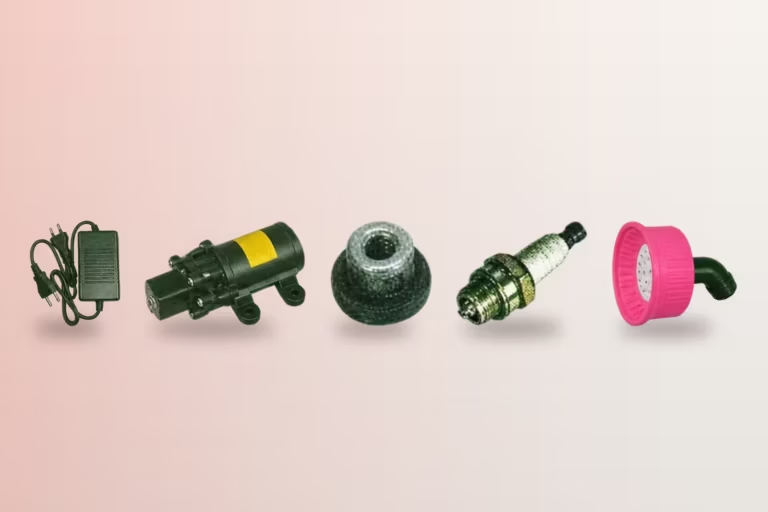
The 2 Stroke Engine Parts group on our spare parts page lists 35 parts by code, including the spark plug, air cleaner assembly, carburetor, easy starter, normal starter and clutch shoes 3. The list does not say which part fits which machine, so send the model code SPS-6500 on WhatsApp and we confirm the fit.
After the Pits Are Dug
Once the trees are in, the next job is keeping them healthy. For spraying tall mango and other fruit trees, see our guide to spraying an orchard with an HTP power sprayer.
How to Buy the SHANKER SPS-6500
The SPS-6500 is sold through SHANKER dealers, not online 1. Before you pay for any earth auger machine, ask the dealer to show you the bits that come with it. Prices change with the season and the district. Send your district on WhatsApp at +91 9752223519 and we reply with today's price and the nearest dealer. You can also see it at the showroom: 11, 45, 52 Shastri Market, Indore 452001 1.
FAQ
That depends on the bit fitted, and the catalogue does not print bit diameters 1. Ask your dealer which bit sizes are in stock, then compare them with the pit size your crop needs.
Not in one bore. TNAU and the Government of India mango package give 1 m x 1 m x 1 m pits 4 5, and that is wider than the auger holes in TNAU's machine tests, which go up to 450 mm 11. Use the auger to break the core of the pit and finish the sides by hand, or ask your horticulture office whether a smaller pit suits your soil, since the National Horticulture Board allows 0.5 m pits in deep loamy soil 6.
The SHANKER page advises: "In hard black soil, dig after a light irrigation or the first rain" 1. Dry, hard soil slows the bit and makes the auger jump. Wait until the ground is firm but not slippery.
Prices change with the season and the district. Send your district on WhatsApp at +91 9752223519 and we reply with today's price for the SHANKER SPS-6500 and the nearest dealer.
Sources
- United Agro Equipment, SHANKER SPS-6500 Earth Auger product page (specifications "As Printed in the SHANKER Catalogue", usage steps, FAQ), read 25 Nov 2026: unitedagroequipment.com Back to Text
- United Agro Equipment, Farm Machines category page, "Fuel and Care for Farm Machines" and FAQ, read 25 Nov 2026: unitedagroequipment.com Back to Text
- United Agro Equipment, Genuine SHANKER Sprayer Spare Parts, "2 Stroke Engine Parts" group, read 25 Nov 2026: unitedagroequipment.com Back to Text
- Tamil Nadu Agricultural University, TNAU Agritech Portal, Horticulture: Mango, "Field preparation": agritech.tnau.ac.in Back to Text
- Directorate of Plant Protection, Quarantine and Storage, Government of India, IPM Package of Practices for Mango (September 2022), reviewed by ICAR Central Institute of Sub Tropical Horticulture, Lucknow, section 4.2 "Planting": ppqs.gov.in Back to Text
- National Horticulture Board, Mango: Planting: nhb.gov.in Back to Text
- Tamil Nadu Agricultural University, TNAU Agritech Portal, Horticulture: Guava, "Planting": agritech.tnau.ac.in Back to Text
- Tamil Nadu Agricultural University, TNAU Agritech Portal, Horticulture: Pomegranate: agritech.tnau.ac.in Back to Text
- Tamil Nadu Agricultural University, TNAU Agritech Portal, Horticulture: Acid lime, "Planting": agritech.tnau.ac.in Back to Text
- Tamil Nadu Agricultural University, TNAU Agritech Portal, Horticulture: Sweet Orange: agritech.tnau.ac.in Back to Text
- Tamil Nadu Agricultural University, TNAU Agritech Portal, Farm Machinery: Post Hole Digger, Tractor Operated: agritech.tnau.ac.in Back to Text
- Tamil Nadu Agricultural University, TNAU Agritech Portal, Farm Machinery: Power Tiller Operated Heavy Duty Auger Digger: agritech.tnau.ac.in Back to Text
- Husqvarna, 541EA Earth Auger Operator's Manual (English section, pages 2 to 16): content.tdr.dss.husqvarnagroup.net Back to Text
- Brave, 200 Series Two-Man Augers Operator's Manual, form GOM08042004US, version 1.1 (2020): cdn.shopify.com Back to Text