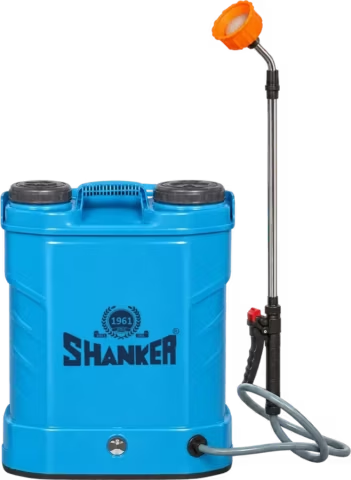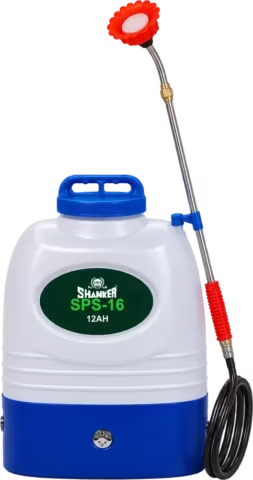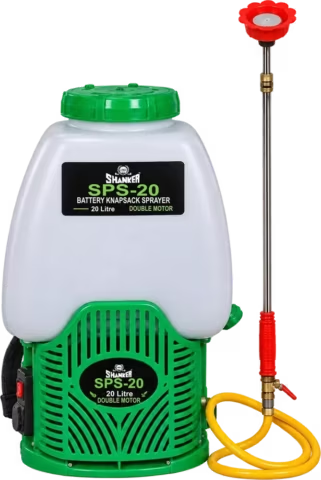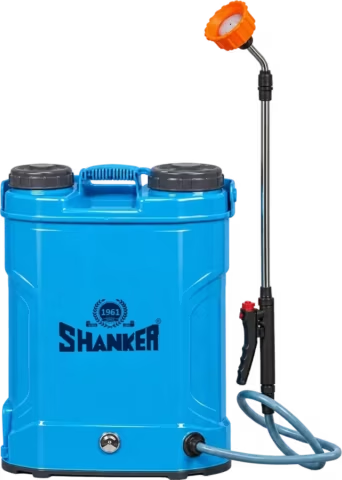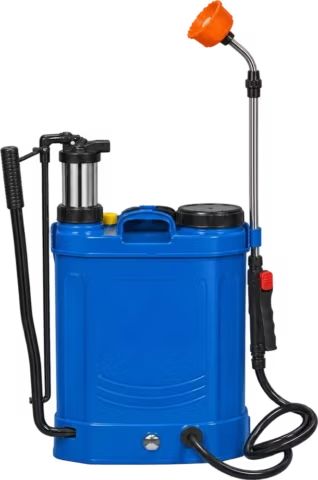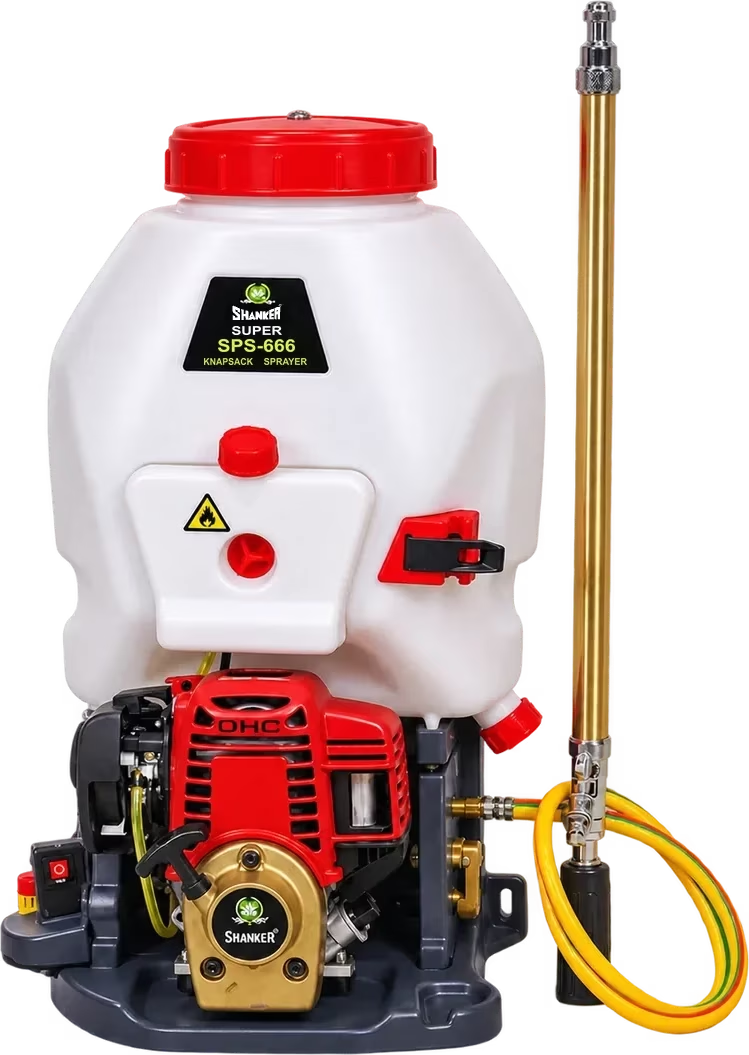

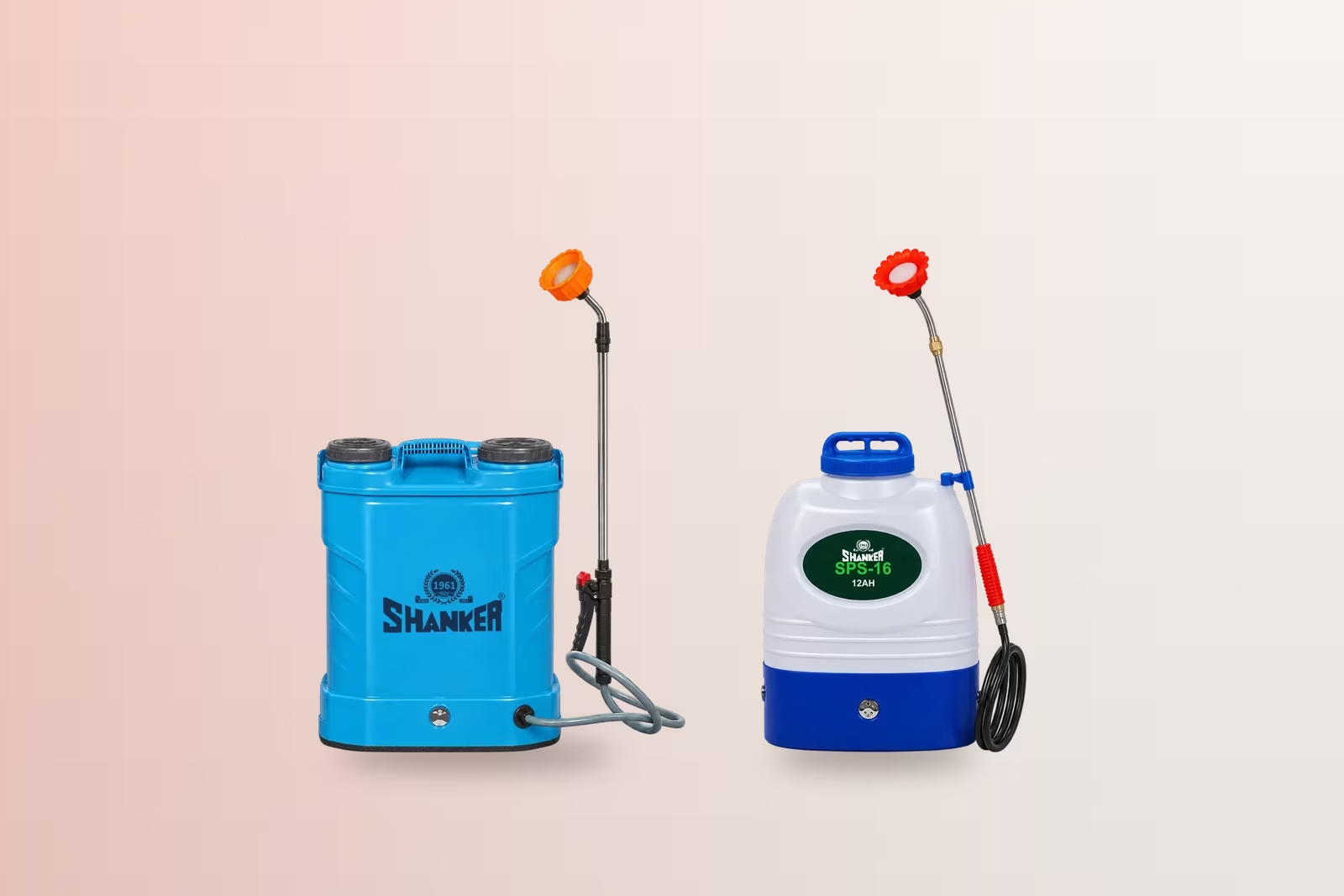
Short answer: When a battery sprayer stops, start with the cheap checks: is the battery charged, are the switch and charge jack connections tight, and are the filter and nozzle clear. If the motor stays silent on a full charge, a fuse keeps blowing, or water leaks from the pump or the base, stop and take it to your dealer.
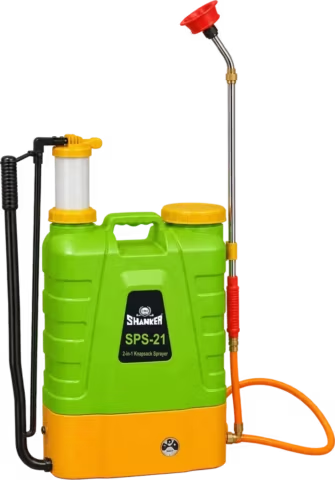
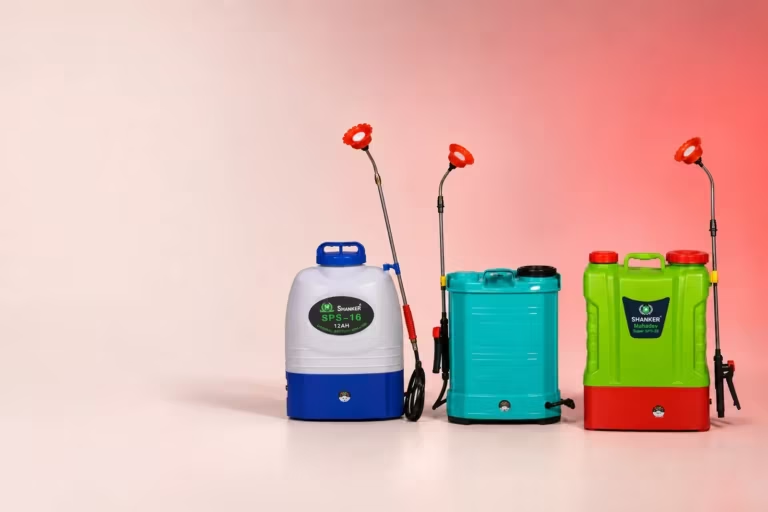
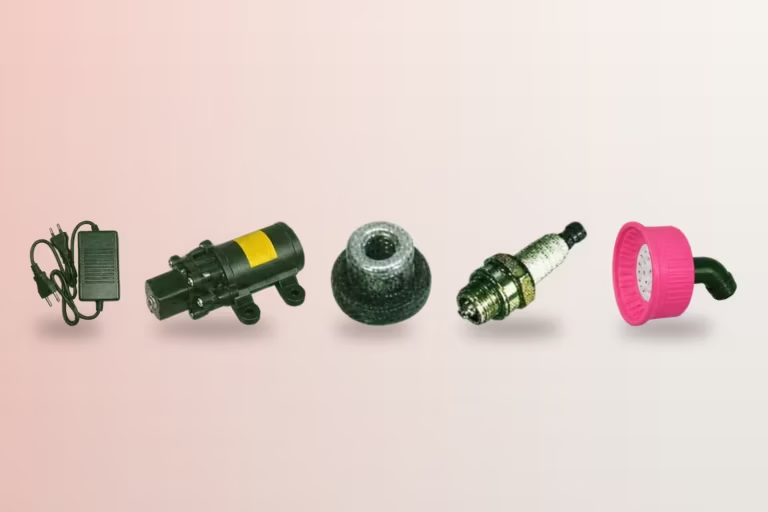
A battery knapsack sprayer "runs a diaphragm pump from a 12 V battery"1. Between the battery and the nozzle sit a few parts that SHANKER sells separately: the power switch, charge jack, regulator, motor, battery, charger, big filter, delivery pipe and ball cock2. A fault in any one of them can stop the spray. This battery sprayer repair guide takes them in order, from the quickest check to the jobs that need a dealer.
Before you start:
- Switch the sprayer off and disconnect the battery before you open the base or touch any wire. One battery sprayer maker's manual says: "Turn the switch to the "OFF" position and remove the battery from the tool before performing troubleshooting procedures"7.
- Empty out any chemical and test on clean water only. Wear gloves if the tank held chemical. Our spraying safety guide has the kit.
- Keep the sprayer, its battery and its own charger together. You will need all three to find the fault.
No Power at All: Battery Sprayer Motor Not Working
You press the switch and nothing happens. No hum, no spray.
- Charge the battery fully with its own charger, then try again. A flat battery is the simplest cause. If the battery was left flat for weeks, read the charging section below before you decide it is dead.
- Check the wires inside the base. With the battery disconnected, look for a loose terminal or a wire that has come off the switch. In a 12V diaphragm pump maker's troubleshooting guide, "Loose Wire at Switch" is listed as a cause of "Pump Won't Start"6.
- Check the battery sprayer switch. A switch that clicks loose, sticks, or works only when you press it hard is worn. Do not keep spraying with it. One maker's manual says: "Do not use the appliance if the switch does not turn it on and off. Any appliance that cannot be controlled with the switch is dangerous and must be repaired"7. SHANKER lists two power switches as spare parts2. Take the old one to the dealer so they match it.
- Check the fuse, if your sprayer has one. A fuse is a planned weak point. Littelfuse, a fuse maker, describes fuses as "intentional weak links in the electrical circuit" that protect the circuit "by reliably melting under overcurrent conditions"8. A blown fuse means too much current flowed. Find out why before you fit a new one, and never fit a bigger one or a piece of wire in its place.
- Let a hot motor cool. If the sprayer stopped in the middle of a hot afternoon, put it in the shade for a while. The pump maker's guide lists "Motor Thermal Overload (Hot Motor)" as a cause of a pump that will not start6, and another sprayer maker's manual says to "Turn off the sprayer and allow the sprayer and the battery pack to cool"7.
- If it is still silent, the motor or the cut-off switch may have failed. The pump maker's guide lists "Bad Motor" and "Bad Microswitch" as causes of a pump that will not start6. SHANKER sells the motor as a spare part in 3.1 L, 3.6 L, 4.6 L and 8 L double motor versions2. This is a job for the dealer.
On a 2 in 1 sprayer you can still finish the day. Parvati SHP-18 and Nandi SPS-21 have an "Option for handle operation if battery gets discharged"1.
Motor Runs but No Spray
The motor hums but nothing comes out of the nozzle. The pump is not getting liquid, or the liquid cannot get out.
- Check the tank. Make sure there is enough liquid to cover the outlet at the bottom.
- Clean the big filter at the tank. In the 12V pump maker's guide, a clogged tank strainer and a clogged tank outlet are both listed under "Pump Will Not Prime" and "Low Flow"6. The big filter is a SHANKER spare part2.
- Look for a kinked or loose hose on the suction side. The same guide lists "Kinked Inlet Hose" and "Inlet Air Leak" as causes of a pump that will not prime6. A loose joint lets the pump suck air instead of liquid.
- Open the ball cock and check the trigger. The ball cock is listed among the battery sprayer parts2. If it is shut, nothing reaches the lance.
- Clear the nozzle. Unscrew it and clean it. The government IPM package says: "Do not blow the nozzle with mouth for any blockages. Clean with water and a soft brush"9. Our nozzle guide covers cleaning in detail.
If the filter, hoses and nozzle are clear and it still will not spray, the pump valves or diaphragm may be worn. The pump maker's guide lists "Dirty/Worn Pump Valves" under both "Pump Will Not Prime" and "Low Flow"6. Take it to the dealer.
Weak or Uneven Spray
The sprayer works, but the spray is thin, short or patchy.
- Charge the battery. A tired battery gives a weak spray. The pump maker's guide lists "Low Voltage" as a cause of "Low Flow"6. When the spray weakens, stop and recharge instead of pressing on. The battery care guide explains why running it flat shortens battery life.
- Check the regulator setting. Models with a regulator, such as SPS-16 and SPS-20, use it to set the spray. Our SPS-16 page puts it this way: "The regulator lets you turn the pump down for weedicide with a flat fan and up for a thicker crop"1. Someone may have turned it down for the last weedicide spray.
- Clean the filter and check the hoses. A blocked filter or a kinked hose on either side of the pump is listed under "Low Flow"6.
- Check the nozzle. A blocked or worn nozzle gives a patchy pattern. See how to tell a nozzle is worn and fit a new one if it fails the jug test.
- Measure the output. Use the calibration method to see how much the sprayer really puts out, and compare it with what it gave when new.
If the spray stays weak on a full battery with a clean filter and a new nozzle, the pump diaphragm may be damaged. The pump maker's guide lists "Ruptured Main Diaphragm" under "Low Flow" and "Leaks"6. That is a dealer job.
Charger and Battery
Daily charging and storage habits are in our battery care guide. This section is about faults.
Battery Sprayer Not Charging
- Check the socket, the charger lead and the charge jack. Look for a cut or crushed lead and a loose jack. The charge jack and both chargers (1.7A and 1.1A) are separate spare parts2, so the dealer can test and replace each one.
- Use the charger matched to your model. Our product pages say: "Use the charger matched to the model"1. One sprayer maker's manual warns that "A charger that is suitable for one type of battery pack may create a risk of fire when used with another battery pack"7.
- Charge in the shade, not in the sun. Yuasa's data sheet for its NP batteries lists charging at 15°C to 50°C4. A battery straight out of a hot field may be above that.
- A battery left flat for a long time may fool the charger. Yuasa's battery manual explains that an over-discharged battery takes very little current at first, and that "the charger may give a false "full charge" indication"3 in that early stage. So a battery that shows full within minutes and then dies in the field may simply have been flat too long. Charge it again and see if it improves.
- Some batteries do not come back. The same manual warns that a lead acid battery "discharged to zero and left in either open or closed circuit for a long period of time" can suffer "severe sulfation", and "In such an extreme case, the battery may not accept a charge"3.
These battery facts come from makers of sealed lead acid batteries. Check the label on your battery. If it says sealed lead acid, SLA or VRLA, they apply.
Heat and Storage
Heat shortens battery life. Narada, a battery maker, states in its manual: "When temperature exceeds 25°C, the battery life will decrease half per 10°C temperature raise"5. Narada also says its batteries need storage that is dry and ventilated and should "avoid direct sunlight"5. Keep the sprayer out of the sun and out of hot tin sheds.
For long storage, Narada's table gives a maximum storage period of "3 months" when the storage temperature is "Above 30°C", and "6 months" below 30°C, before the battery should be recharged5. If the room stays hot through summer, top up the charge more often.
When a Battery Is Finished
- It runs far fewer tanks than it used to, even after a full overnight charge. SHANKER rates its knapsack models at "448-480 liter (25-30 pumps) solution at fully charged once"1, but nozzle, walking speed and battery age change that figure1.
- The case is cracked, swollen or leaking. Yuasa's manual says: "If, at any time, cracks, deformation or other damage is found on the battery case or cover, or if any leakage of the electrolyte is observed, immediately replace the battery"3.
- Before you buy a new battery, ask the dealer to test the charger and the charge jack. A fault there can look like a dead battery.
- Replace it with the same size. SHANKER lists a "12/12AH Battery" and a "Battery 8AH" as spares2. Your model's product page shows which one it takes1.
Battery life depends most on how deep you drain it. Yuasa's manual puts it plainly: "Generally speaking, the most important factor is depth of discharge"3.
Leaks
A leaking sprayer puts chemical on your back. The government IPM package says simply: "Do not use leaky, defective equipment"9.
- Tank cap: make sure it is screwed down straight and its seal is not torn. The tank cap is a spare part2.
- Hose joints: one sprayer maker's manual lists the cause of leaking joints as "end caps of connection joints not screwed on tightly or the o-ring is cracked or damaged", and the fix as "Tighten the end caps. Replace the o-ring if necessary"7. Check the delivery pipe and rubber elbow too; both are spares2.
- Lance and trigger: if the lance drips when you let go of the trigger, the trigger or its seal needs checking. Parvati SHP-18 and Nandi SPS-21 have a "leak proof auto cut-off device"1, so a drip on these means a fault.
- Pump and base: water around the pump points to a loose screw, a loose fitting or a damaged diaphragm. The pump maker's guide lists "Loose Pump Screws", "Loose Pump Fittings" and "Ruptured Main Diaphragm" under "Leaks"6. Stop using it. Liquid near the battery and wiring is a risk: one maker's manual says never to "allow a liquid to flow inside" the tool, battery pack or charger7.
- Battery: if the battery itself leaks, do not touch the liquid. Yuasa warns: "The electrolyte contains sulfuric acid which can cause serious damage to eyes and skin. Should this occur, flush profusely with water and seek medical attention"3.
What Not to Do
- Never bypass the fuse. Do not fit a bigger fuse, a wire or foil in its place. The fuse is the "intentional weak link"8 that melts before the wiring does.
- Never open the charger or the battery. One sprayer maker's manual says: "Never disassemble the tool, battery pack or charger"7. Yuasa says: "Do not crush, incinerate or dismantle the battery"3. A faulty charger goes back to the dealer.
- Never charge near petrol, diesel, flame or smoking. Yuasa warns that "Batteries may generate ignitable gases which must not be contained" and "should not be installed near spark producing equipment"3. Narada's manual says: "do not smoke or use fire near batteries"5. Keep the charging spot away from petrol cans and petrol sprayers.
- Never charge in a closed box or trunk. Yuasa's data sheet says: "On no account should the battery be charged in a sealed container"4.
- Always disconnect before opening. "Disconnect the battery pack from the appliance before making any adjustments, changing accessories, or storing appliance"7.
- Do not short the battery terminals with a spanner or pliers. Narada warns that "shock or short circuit could be caused when replacing the batteries. Please operate with tools with insulated handles"5.
- Do not handle the charger with wet hands. One maker's manual says: "Do not handle the charger, including charger plug, or charger terminals with wet hands"7.
When to Take It to the Dealer
Take the sprayer to your SHANKER dealer when:
- the motor stays silent on a fully charged battery after you have checked the wires and switch;
- a fuse blows again soon after you replace it;
- the motor runs but there is still no spray after you clean the filter and nozzle;
- the spray stays weak on a full battery with a clean filter and a good nozzle;
- water leaks from the pump or inside the base;
- the battery is swollen, cracked or leaking;
- the charger gets very hot, smells of burning, or its lead is damaged.
Bring the sprayer, its battery and its own charger together, with the model code from the sprayer. Parts are listed by code on our spare parts page. If you are far from a dealer, send the model code or a photo on WhatsApp at +91 9752223519 and we will tell you the part and the nearest dealer.
Dealers: our guide to running a sprayer service counter lists the battery sprayer spares to keep on the shelf.
FAQ
With the battery disconnected, check for a loose wire at the switch and battery terminals. Check the switch and the fuse, if there is one. Let a hot motor cool in the shade. If it is still silent, take it to the dealer to test the motor and the cut-off switch6.
It runs far fewer tanks than before on a full charge, or the case is cracked, swollen or leaking3. Ask the dealer to test the charger and charge jack first.
From your SHANKER dealer. The full list, with codes, is on our spare parts page.
Sources
- United Agro Equipment, SHANKER battery knapsack sprayer pages: Battery Knapsack Sprayers category, Ganesh SHP-12, SPS-16, SPS-20, Parvati SHP-18, Nandi SPS-21. Read 25 Nov 2026. Back to Text
- United Agro Equipment, Genuine SHANKER Sprayer Spare Parts, "Battery Sprayer Parts" group (46 parts): unitedagroequipment.com/spare-parts. Read 25 Nov 2026. Back to Text
- Yuasa, Inc., "NP series sealed rechargeable lead-acid battery, Application Manual", Rev. 5/00, sections "Over-Discharge (Deep Discharge)", "Recovery Charge After Deep Discharge", "Expected Service Life of NP Batteries" and "Tips and Precautions": cdn.adiglobaldistribution.co.uk (distributor copy). Back to Text
- GS Yuasa, NP Series, NP 7-6 product data sheet ("Valve Regulated Design", "Operating temperature range"): cdn.adiglobaldistribution.co.uk (distributor copy). Back to Text
- Narada Power Source Co., "Valve Regulated Sealed Lead Acid Battery, 6V & 12V Series, Operation Manual", Version V1.0, warnings, temperature and storage sections: communityarchive.victronenergy.com. Back to Text
- Pentair SHURflo, "Pump Troubleshooting Guide" (12V diaphragm pumps), symptom and cause table: pentair.com. Back to Text
- Kobalt, Backpack Sprayer Model KBSP 1040B-03 (40 V battery backpack sprayer), manual sections "Safety Information", "Care and Maintenance" and "Troubleshooting": pdf.lowes.com. Back to Text
- Littelfuse, "Fuseology Design Guide", section "Fuse Characteristics, Terms, and Consideration Factors": info.littelfuse.com. Back to Text
- Directorate of Plant Protection, Quarantine and Storage and NIPHM, Integrated Pest Management Package for Soybean (2014), "Operational, calibration and maintenance guidelines in brief" and "Equipments": niphm.gov.in. Back to Text