
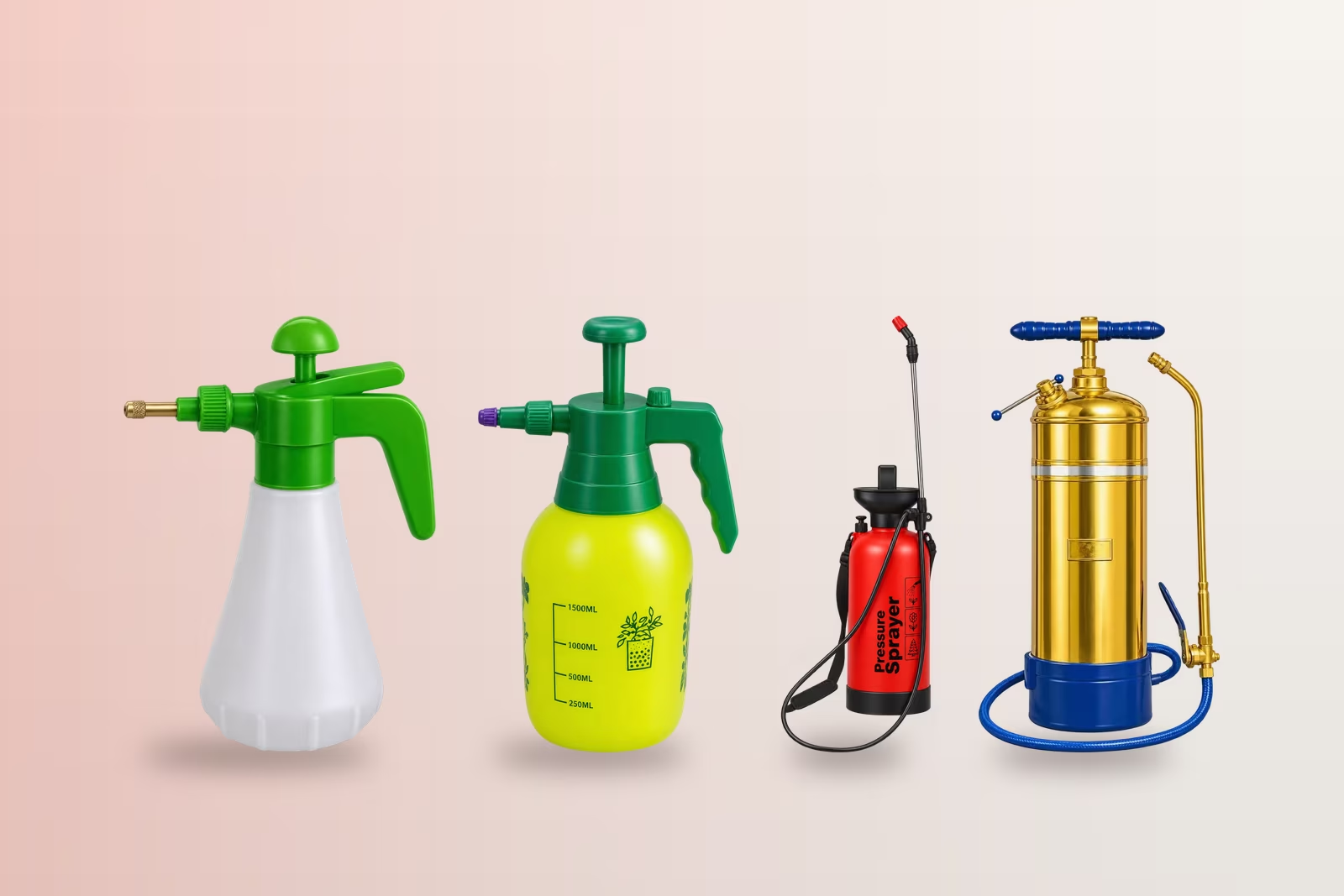
Short answer: For house plants and a balcony, a 1 L pressure bottle is enough; for a terrace garden, the 1.5 or 2 L bottle; for a kitchen garden or polyhouse, a 5 or 8 litre garden pressure sprayer with a strap; and for nursery rows, the brass Varsha in 3.5 to 12 L 1 2 3 4. Whatever the size, pump it up, release the pressure before you open it, and keep one sprayer for pesticide and another for water and plant feed 1 7 11.
A hand sprayer mists seed trays, carries foliar feed and neem spray, and sanitizes a shed 1 2 4. This guide covers which size fits which job, how a pressure sprayer works, and how to fill, clean, store and use one safely in a house with children and pets.
Every SHANKER fact here comes from our own product pages, as printed in the SHANKER catalogue 5. Pump and cleaning steps come from sprayer makers' manuals, and safety advice from university and Government of India sources.
Which Size for Which Job
The four SHANKER hand sprayer sizes
| Sprayer | Tank | What the product page lists it for |
|---|---|---|
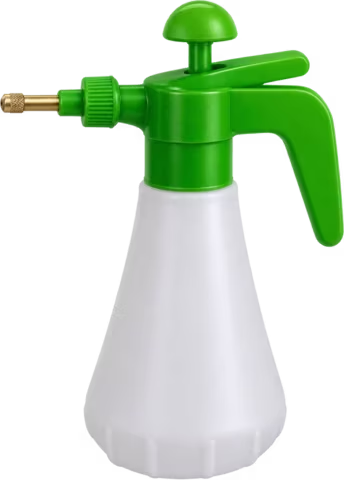
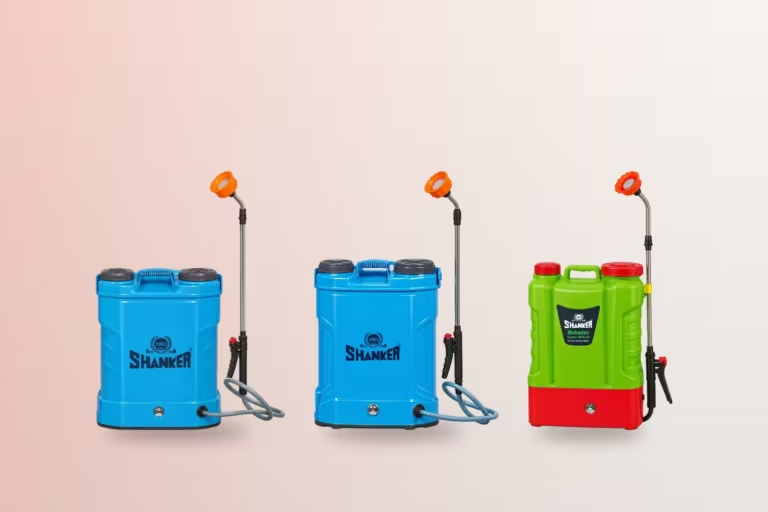
| Hand Sprayer, 1 L | 1 L, plastic | House plants, balcony, sanitizing 1 |
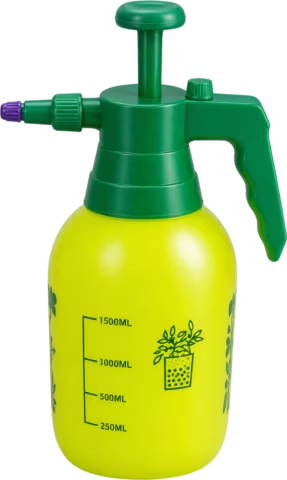
| Hand Sprayer, 1.5 L and 2 L | 1.5 or 2 L, plastic | Terrace garden, cleaning, small nursery 2 |
| Hand Sprayer, 5 L and 8 L | 5 or 8 L | Kitchen garden, polyhouse, shed 3 |
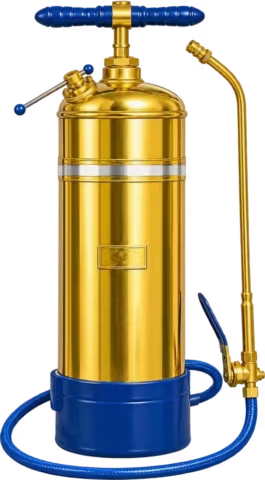
| Varsha VR-18 to VR-21 | 3.5, 6, 9 or 12 L, brass | Nursery, grape, sheds 5 |
All three plastic hand sprayers are listed for watering, fertilizing and sanitizing, with one adjustable nozzle and a funnel top 1 2 3.
1 L: house plants and a balcony
The 1 L bottle is the smallest SHANKER pressure bottle. Its page lists it for "house plants, seed trays, foliar feed and sanitizing" 1. It is the hand sprayer for plants on a window sill or a few balcony pots.
1.5 L and 2 L: a terrace garden
The middle size "holds enough for a terrace garden or a row of grow bags in one fill and is still easy to lift with one hand" 2. The page lists it for foliar feed, neem spray on vegetables, cleaning and sanitizing 2.
5 L and 8 L: a kitchen garden or polyhouse
The 5 litre pressure sprayer, also sold in 8 L, sits "between a bottle and a knapsack" and carries a shoulder strap 3. Its page says "One fill covers a kitchen garden or a small polyhouse bay" 3. It is the only plastic SHANKER hand sprayer with a built-in filter and an extendable handle, so you can reach "shelves, creepers and shed walls" 3.
Varsha 3.5 to 12 L: nursery rows and sheds
The Varsha is a hand compression sprayer with a brass alloy tank in four sizes 4:
| Model | Tank | A good fit for (as printed) |
|---|---|---|
| VR-18 | 3.5 L | Kitchen garden, polyhouse trays, seedling beds |
| VR-19 | 6 L | Nursery rows, house and shed spraying |
| VR-20 | 9 L | Vegetable plots and grape rows |
| VR-21 | 12 L | Larger plots, mosquito and public health spraying |
The tank is cold rolled brass alloy sheet with welded joints, "Tested to 150 psi", with brass forged fittings and a provision for a pressure gauge 4. It comes with a 110 cm delivery hose, a trigger cut-off, a 60 cm extension rod with a gooseneck end and a fine mist nozzle 4. A nursery owner who sprays every day will find the hose and rod easier than holding a bottle up at arm's length.
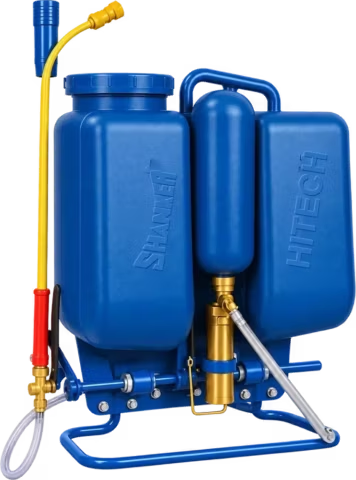
If you spray a farm plot rather than a garden, look at a 16 L manual knapsack such as the Hitech SRH-5 1.
How a Garden Pressure Sprayer Works
A spray bottle for plants with a squeeze trigger needs a squeeze for every puff. A pressure sprayer works the other way round. You pump air into the closed tank first, then the trigger lets the liquid out under that pressure. The SHANKER 1 L page puts it simply: "Pump the top, press the trigger, and it sprays without squeezing again and again" 1.
Chapin, a US sprayer maker, gives the same steps in its manual for a 1 gallon garden sprayer 6:
- "Pump until you feel resistance."
- Lock the handle and begin spraying.
- "Re-pump sprayer as required to maintain spray force."
The Varsha page says the same in field terms: "Spray with the trigger cut-off; pump again when the cone gets weak" 4.
Release the pressure before you open it
This is the step people skip. Husqvarna's manual for its handheld pressure sprayer says: "Always release pressure when sprayer is not in use and before removing pump from tank" 7. Chapin adds: "Never use any tool to remove pump if there is pressure in sprayer" and "Never stand with face or body over top of tank when pumping or loosening pump" 6.
If your sprayer has a pressure release valve, use it. For sprayers without one, Chapin's steps are: "With pump facing away, turn locked handle counterclockwise until air begins to escape. Stop turning handle when you hear air escaping" and "Point pump away until all air has escaped" 6.
One more line from Chapin matters on an Indian terrace in May: "Do not leave a pressurized sprayer in the hot sun. Heat can cause pressure build-up resulting in possible explosion" 6.
Filling: Below the Mark, Through the Funnel, Through a Filter
- Release the pressure first. Husqvarna: "Always make sure the pressure is released from the tank before filling or servicing" 7.
- Pour through the funnel top. All three plastic SHANKER sprayers have one 1 2 3.
- Strain the liquid. The SHANKER pages say "strain the liquid and leave air space" 1. The 5 and 8 L models also have a built-in filter 3. Neem and homemade mixes leave bits that block a fine nozzle.
- Stay below the mark. Chapin: "Fill tank to no more than the proper gallon marker. Do NOT: overfill to accommodate pump" 6. The Varsha page says "Fill to the mark and leave air space above the liquid" 4. The air space is what you pump up; a full tank leaves nothing to compress.
- Test with water first. Husqvarna: "TEST SPRAYER WITH WATER BEFORE USING ANY CHEMICALS" 7. Watch for leaks at the cap and hose; the Varsha page says to stop if you see one 4.
For the spray pattern, turn the nozzle: "fine mist for leaves, jet for corners" 1. For a field sprayer's nozzles, see our sprayer nozzle guide.
One Sprayer for Chemicals, Another for Water and Feed
Keep two sprayers, and mark them. The Government of India IPM package for cotton says plainly: "Do not use same sprayer for weedicide and insecticide" 11. Clemson University Extension explains why: "Even after careful rinsing, a sprayer can contain herbicide residues that can injure or kill sensitive plants" 8. It advises "a separate sprayer for the herbicides and a separate sprayer for insecticides" 8.
For a home garden, the SHANKER pages give the simple version: "Keep one bottle for plant feed and water and a separate, marked one for pesticide or sanitizer. Never reuse a pesticide bottle in the house" 1.
A practical setup for a terrace or small nursery:
- Bottle 1, clean only: water, foliar feed, misting seedlings.
- Bottle 2, marked "PESTICIDE": insecticide, fungicide, neem.
- A third sprayer for weedicide, if you use one at all, kept well away from the other two.
Cleaning After Chemical Use
Clean the sprayer the same day. Clemson's sprayer clean-out note says "leaving chemicals in your sprayer for long periods of time can cause deterioration, cracks, and grime to build up" 9. Its triple rinse steps 9:
- "Fill the sprayer 1/5 to ¼ with water."
- "Replace the closure and rotate the container."
- "Drain the rinsate in an area approved to treat on the label."
- "Repeat these steps two more times."
Clemson adds: "take off and clean the nozzles, screens, and filters separately" and "Clean your sprayer away from children and pets" 9. The Government of India IPM package says "Wash the sprayer and bucket etc. with soap water after spraying" 11. Spray clean water through the nozzle too: Chapin says "Be sure that the wand and nozzle are thoroughly rinsed with water after each use" 6.
Where the rinse water goes matters at home. NDSU Extension: "Don't pour remaining chemicals down the drain" 10. The IPM package: "Leftover spray solution should not be drained in ponds or water lines etc." 11. On a terrace, the floor drain runs to the same lines.
If the nozzle blocks, do not blow through it. The IPM package says "Use old tooth- brush tied with the sprayer and cleans with water" 11.
Storing a Hand Sprayer
- Empty and open. Husqvarna: "Do not store or leave any solution in the tank after use" 7. Chapin: "Store sprayer tank upside down, with pump removed, in a warm dry location" 6. The Varsha page says "store with the lid off" 4.
- Out of the sun. Husqvarna: "Store in a warm, dry location out of direct sunlight" 7.
- Out of reach. Husqvarna: "Keep the sprayer and all chemicals out of the reach of children" 7.
- Away from the kitchen. The IPM package: "Containers, buckets etc. used for mixing pesticides should not be used for domestic purposes" 11.
Safety at Home: Children, Pets, Food and Wind
A terrace or kitchen garden is metres from where the family eats and plays. The university advice for home gardeners:
- Children and pets out. Clemson: "Keep people, especially children, and pets, out of the area you are treating" 8. It also says to "Remove toys, pet feeding dishes, and any other items that might be contaminated by the pesticide from the treatment area" 8.
- Wait before they come back. "The pesticide label may tell you to keep children or pets out of the treated area until the spray dries or for 24 hours" 8.
- Food plants. NDSU: "The pesticide should not be applied closer to harvest than directed on the label" 10. Then "Wash fruits and vegetables thoroughly under running water" 10.
- No eating while spraying. NDSU: "Do not eat, drink or smoke when using pesticides because traces of the chemicals may be transferred from hand to mouth" 10.
- Wind. NDSU: "Don't spray on a windy day (above 10 miles per hour or above label limits) because the spray could drift on you or into a neighbor's yard" 10. Ten miles per hour is about 16 km/h. On a terrace, the neighbour's washing line is closer than you think.
- Gloves. Clemson: "Don't wear leather gloves. Wear rubber gloves made to resist pesticides" 8. Sprayer makers ask for goggles and gloves too 6 7.
For label colours, the full protective kit and what the Insecticides Rules say, read our safe spraying guide.
For Dealers
The 1 L and the 1.5 or 2 L bottles are packed 20 per box, and the 5 and 8 L sprayers 6 per box 1 2 3. Our product pages note that hand sprayers "sit well beside seeds, pots and garden tools" 1. Ask on WhatsApp for the box rate, or apply for a SHANKER dealership.
Price and Where to Buy
Prices change with the season and the district. Send your district on WhatsApp at +91 9752223519 and we reply with today's price and the nearest SHANKER dealer 1. You can also see the range at our showroom: 11, 45, 52 Shastri Market, Indore 452001 1.
FAQ
The space above the liquid is the air you pump up. Chapin's manual says to fill "to no more than the proper gallon marker" and not to overfill to make room for the pump 6. A tank filled to the brim leaves nothing to compress.
Prices change with the season and the district. Ask on WhatsApp at +91 9752223519 with your district and we reply with today's price 1.
Sources
- United Agro Equipment, SHANKER Hand Sprayer, 1 L (product page, specifications as printed in the SHANKER catalogue), read 25 Nov 2026: unitedagroequipment.com Back to Text
- United Agro Equipment, SHANKER Hand Sprayer, 1.5 L and 2 L (product page), read 25 Nov 2026: unitedagroequipment.com Back to Text
- United Agro Equipment, SHANKER Hand Sprayer, 5 L and 8 L (product page), read 25 Nov 2026: unitedagroequipment.com Back to Text
- United Agro Equipment, SHANKER Varsha VR-18 / VR-19 / VR-20 / VR-21 Hand Compression Sprayer (product page), read 25 Nov 2026: unitedagroequipment.com Back to Text
- United Agro Equipment, Hand Operated Sprayers (category page), read 25 Nov 2026: unitedagroequipment.com Back to Text
- Chapin International, owner's manual for Model 16100 and 16200 lawn and garden sprayers, form 016106R1022: cdn.shopify.com Back to Text
- Husqvarna, 48 oz Handheld Sprayer Use and Care Manual, Manual No. 183857, Rev. A 10/24/18: husqvarna.com Back to Text
- Clemson Cooperative Extension, Home and Garden Information Center, Pesticide Application Tips, HGIC 2752, Robert G. Bellinger (updated 31 Mar 2023): hgic.clemson.edu Back to Text
- Clemson Cooperative Extension, Home and Garden Information Center, Sprayer Clean-Out, Katie Moore (18 Apr 2024): hgic.clemson.edu Back to Text
- NDSU Extension, Pesticide Safety: A Guide for Gardeners and Homeowners, H1096, Julie Garden-Robinson, Greg Dahl and Andrew A. Thostenson (reviewed April 2022): ndsu.edu Back to Text
- Directorate of Plant Protection, Quarantine and Storage and NIPHM, Government of India, Integrated Pest Management Package for Cotton (2014), safety sections B to G: niphm.gov.in Back to Text