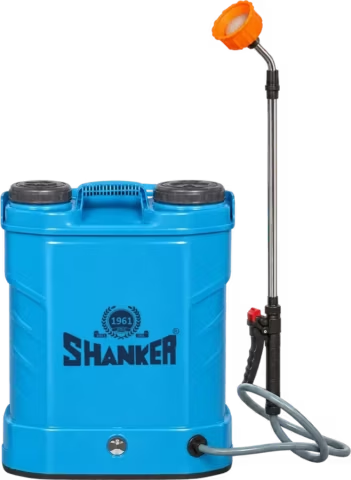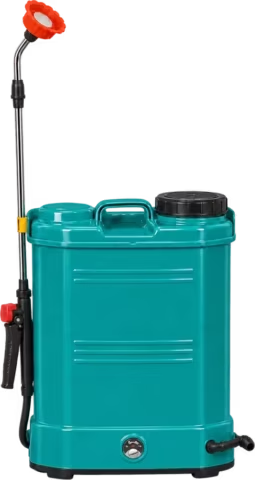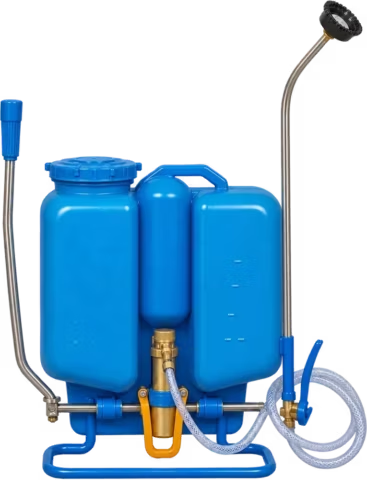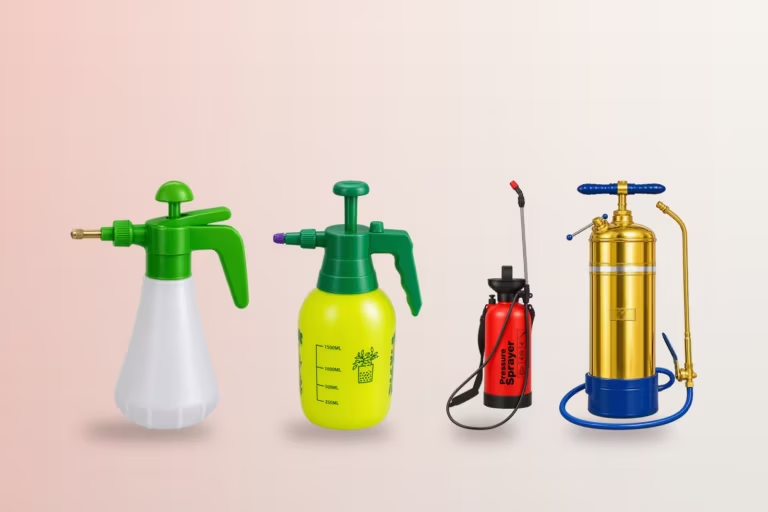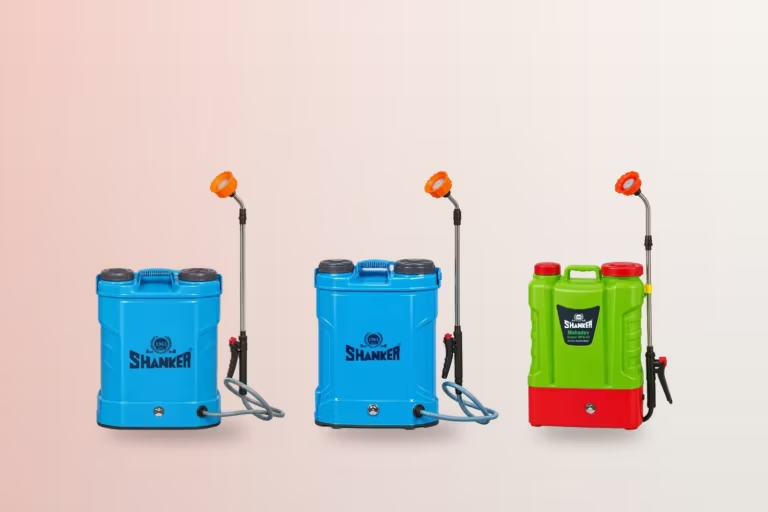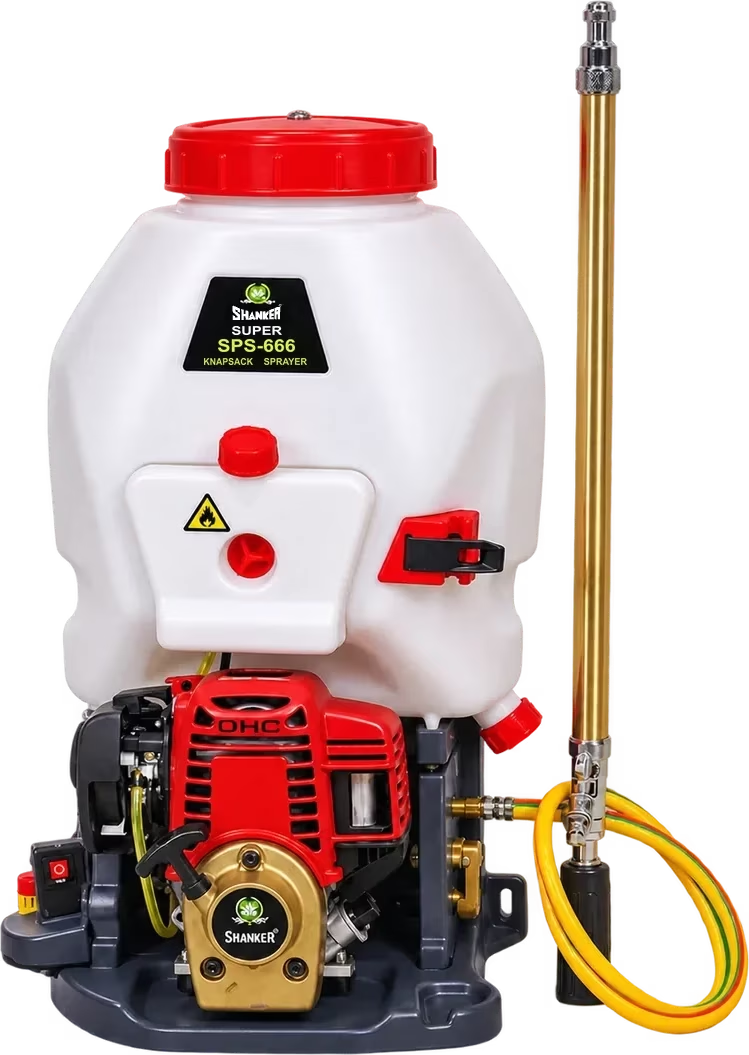

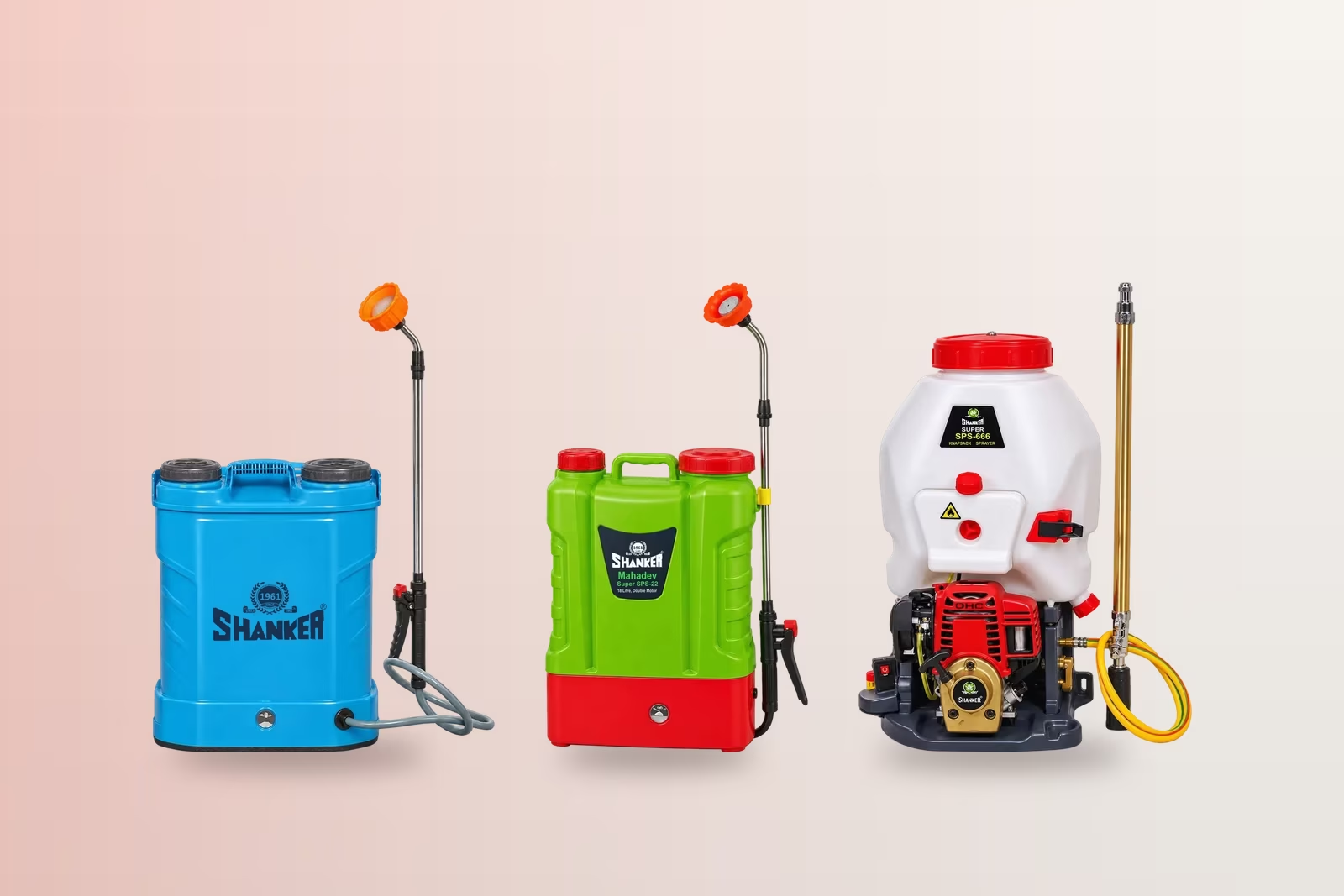
Short answer: In the 16 litre vs 20 litre sprayer choice, the 20 L tank saves you two or three refills per acre, but every fill puts about 4 kg more on your back. Pick 16 L when one person sprays all morning or the load already feels heavy, and pick 20 L (or 18 L as a middle step) when a strong operator sprays wide fields and walking back to the drum is what slows the day down.
At the dealer's counter, knapsack sprayer tank size is usually the second question after battery or petrol. A bigger tank looks like better value. It is not always. This guide works out the weight on your back, the number of refills per acre at the spray volumes our agriculture institutes give, and which SHANKER models come in each size. Every SHANKER figure comes from the product pages 123.
If you have not yet chosen between battery, petrol and HTP, read battery, petrol or HTP sprayer first. If you are choosing between single and double motor battery models, that is covered in double motor or single motor battery sprayer, so we do not repeat it here.
16 Litre vs 20 Litre Sprayer: Weight on Your Back
Water weighs about 1 kg per litre, and a spray mix is mostly water. So the liquid alone weighs about as many kilos as the tank holds litres.
| Tank, filled to the brim | Liquid on your back | Machine weight printed on the SHANKER page? |
|---|---|---|
| 16 L | about 16 kg | Not printed |
| 18 L | about 18 kg | Not printed |
| 20 L | about 20 kg | Not printed |
| 25 L | about 25 kg | Not printed |
On top of the liquid you carry the tank, pump, battery or engine, lance and straps. None of the SHANKER product pages prints an empty weight, for battery, petrol or manual models 123. So we cannot give you a full weight for any model. Ask the dealer to weigh it, or use the test further down.
The difference between 16 L and 20 L is 4 kg on every fill. That 4 kg rides on your shoulders and lower back for every row you walk.
Refills per Acre at Real Spray Volumes
The tank size does not change how much water an acre needs. It only changes how many times you walk back to fill, and that is where the 16 litre vs 20 litre sprayer difference shows up in a working day.
How much water per acre? These are the published figures that matter most in Madhya Pradesh:
- Soybean: the ICAR Indian Institute of Soybean Research, Indore, says "soybean requires 500 lit spray solution per ha with knapsack sprayer and 120 lit/ha with power sprayer. Spraying with less quantity will not give desired results" 4. For weedicide it advises "500 litre of water per hectare along with recommended quantity of herbicides using Flat Fan or Flood Jet nozzle" 4. One hectare is about 2.5 acres, so 500 litres per hectare is about 200 litres per acre.
- Cotton: the ICAR Central Institute for Cotton Research advises "150-200 litres of water /acre or 375-500 litre/ ha for dilution of the insecticides" 6.
- General knapsack spraying: Punjab Agricultural University gives "150 litres of water per acre for post emergence application" of weedicide, "200 litres of water for control of diseases and 100-150 litres of water per acre for control of insect pests" 5.
So most sprays land between 150 and 200 litres per acre. Here is what that means for each tank:
| Tank size | Fills per acre at 150 L | Fills per acre at 200 L (soybean, ICAR) | Trips to the drum at 200 L |
|---|---|---|---|
| 16 L | 9.4 | 12.5 | 13 |
| 18 L | 8.3 | 11.1 | 12 |
| 20 L | 7.5 | 10 | 10 |
| 25 L | 6 | 8 | 8 |
These are our sums: litres per acre divided by tank size. Your own figure depends on your nozzle and walking speed, so measure it once a season with the knapsack sprayer calibration method.
Look at the total. On one acre of soybean you carry about 200 kg of spray across the field whichever tank you buy. A 20 L tank does not cut that load. It cuts the walks back, about 2 to 3 fewer per acre than a 16 L tank, and it makes each walk 4 kg heavier.
On a 3 acre soybean day at 200 litres per acre, that is about 38 fills with a 16 L tank against 30 fills with a 20 L tank.
Does a bigger tank spray more on one charge or one litre of petrol?
Battery: no, not as printed. Every SHANKER battery knapsack page, 16 L, 18 L or 20 L, gives the same line: "Battery works for spraying 448-480 liter (25-30 pumps) solution at fully charged once" 1. At 200 litres per acre, that is a little over 2 acres per charge; at 150 litres, about 3 acres. A bigger tank needs fewer refills for the same area. It does not spray more litres per charge. The double motor guide goes into this.
Petrol: the pages print fuel use as tank fills of the 20 L tank per litre of petrol: 22 to 24 for the 2 stroke SPS-708 and SPS-111, and 26 to 28 for the 4 stroke SPS-768, SPS-555 and SPS-666 2.
Who Should Carry 20 or 25 Litres, and Who Should Not
What the guidelines say
The FAO, the United Nations food and farming body, sets minimum standards for sprayers carried by the operator. Its first general rule is: "Total mass when filled to the manufacturers recommended maximum capacity should not exceed 25 Kg" 7. That limit is for the whole sprayer when full: liquid, tank, pump, power source and straps.
- A 25 L tank filled to the brim already holds about 25 kg of liquid. Once the engine, pump and frame are added, it is over the FAO figure.
- A 20 L tank filled to the brim holds about 20 kg, which leaves 5 kg for everything else. Since the SHANKER pages do not print empty weights, we cannot tell you which side of 25 kg a full 20 L model lands on. Weigh it.
- A 16 L tank leaves 9 kg for the machine.
The International Labour Office's farm ergonomics manual makes the general point about carrying: "two packages of 10 kg each are much better than one package of 20 kg", and "A lighter weight is a safer weight" 8. It is written about sacks and crates, not sprayers, but the idea is the same: a lighter load with more trips is easier on the body than a heavy one with fewer.
We did not find an ICAR or Indian government rule that sets a maximum sprayer weight for farm workers, so we will not invent one.
Who a 20 L tank suits
The product pages describe the 20 L battery models this way 1:
- Mahadev SHP-21 is for "early-season cotton, soybean at canopy closure, wheat weedicide on wide fields, and any farm where walking back to refill costs the most time".
- SPS-20 is "for contract sprayers and large families who share one machine all season".
In plain words: a 20 L tank suits one regular operator who is comfortable with the load, on wide fields where the water point is far from the rows.
Who should stay with 16 L or 18 L
- If the person who sprays finds a full 16 L heavy by noon, a 20 L tank is not for them. The Ganesh SHP-12 page says "The 16 L tank keeps the filled weight moderate, which matters when the same person sprays for a full morning" 1.
- If 20 L is heavy by evening, the 18 L tank is the middle step. The Mahadev Super SPS-22 suits "operators who find a filled 20 L sprayer heavy by the end of the day", with a separate skirt and heavy belt 1.
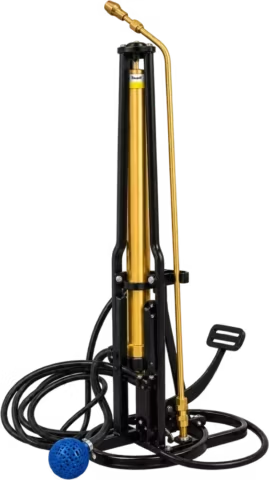
- If anyone in the family cannot carry a knapsack at all, the SHANKER Portable Battery Sprayer "keeps the weight off your back" and "helps operators who cannot carry 16 to 20 litres" 1. It draws from a drum or bucket. The Everest ET-8 foot sprayer also works from a drum 3.
A simple test at the dealer
- Ask the dealer to fill the 16 L and the 20 L models with plain water to the top.
- Stand on a weighing scale with the sprayer on your back, then without it. The difference is the full weight you will carry.
- Walk 100 steps with each one and lift the lance as you would in the field.
- Choose the one you could carry for a full morning, not the one you can lift once.
The SPS-666 page gives the same advice for its larger tank: "A full 25 L tank is also heavier on the back, so try both on water at the dealer" 2.
On a tired day you can fill a 20 L tank to 16 L. Then count your fills by 16 L and split the dose to match, as the calibration guide explains. Never guess the dose per tank.
SHANKER Knapsack Sprayers by Tank Size
Only what the product pages print 123. Prices change with the season and the district, so ask on WhatsApp at +91 9752223519 for today's price.
| Tank | Model | Type | Power, as printed | Hand lever |
|---|---|---|---|---|
| 16 L | Ganesh SHP-12 | Battery | 12V 8 / 12Ah, 100 PSI pump | No |
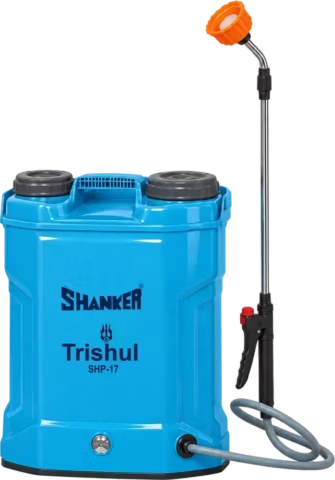
| 16 L | Trishul SHP-17 | Battery | 12V 8 / 12Ah, 100 PSI pump | No |
| 16 L | Kartikeya SHP-19 | Battery | 12V 8 / 12Ah, 100 PSI pump | No |
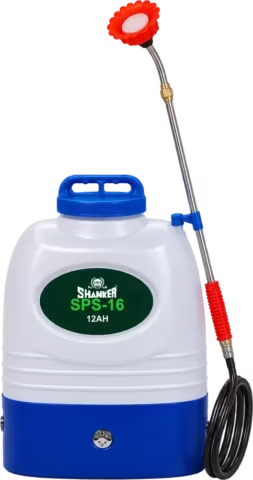
| 16 L | SPS-16 | Battery | 12V 12Ah, 110 PSI pump | No |
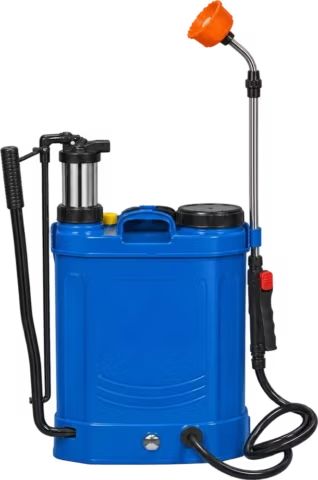
| 16 L | Parvati SHP-18 | Battery and manual (2 in 1) | 12V 8 / 12Ah, 100 PSI pump | Yes |
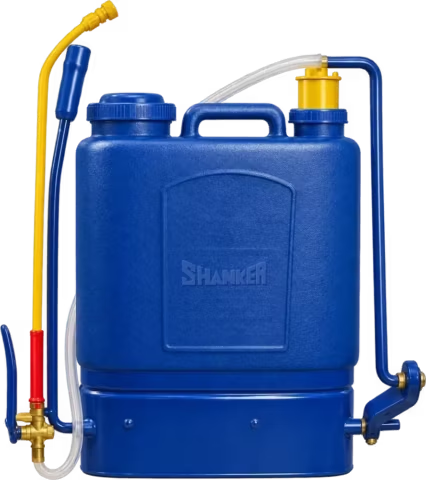
| 16 L | SRP-4 | Manual | Hand lever, brass pressure chamber | Hand only |
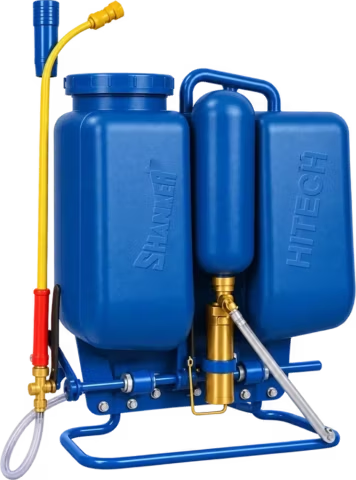
| 16 L | Hitech SRH-5 | Manual | Hand lever, removable stand | Hand only |
| 16 L | Hitech SRH-5A | Manual | Hand lever, molded fixed stand | Hand only |
| 18 L | Mahadev Super SPS-22 | Battery, double motor | 12V 12Ah, 110 PSI double pump | No |
| 18 L | Nandi SPS-21 | Battery and manual (2 in 1) | 12V 8 / 12Ah, 110 PSI pump | Yes |
| 20 L | Mahadev SHP-21 | Battery, double motor | 12V 12Ah, 110 PSI double pump | No |
| 20 L | SPS-20 | Battery, double motor | 12V 12Ah, 110 PSI double pump | No |
| 20 L | Power SPS-708 | Petrol | 2 stroke 26 cc | No |
| 20 L | Super Power SPS-111 | Petrol | 2 stroke 26 cc | No |
| 20 L | Power SPS-768 | Petrol | 4 stroke 31 cc | No |
| 20 L | Super Power SPS-555 | Petrol | 4 stroke 31 cc | No |
| 20 or 25 L | Super Power SPS-666 | Petrol | 4 stroke 35 cc | No |
What the table shows:
- Every manual knapsack in the range is 16 L. The smaller Varsha compression sprayers come in 3.5, 6, 9 and 12 L for nurseries and spot work 3.
- Battery models come in 16, 18 and 20 L. There is no 25 L battery model.
- Every petrol knapsack is 20 L, and the SPS-666 is the only model with a 25 L option.
How to Choose: A Quick Way to Decide
- One person sprays, small or mid-size plots, or the load already feels heavy: 16 L. Ganesh, Trishul, Kartikeya or SPS-16 on battery, Parvati if you want a hand lever, SRP-4 or Hitech if you want no battery at all.
- Want fewer refills but 20 L is too much by evening: 18 L, Mahadev Super SPS-22 or Nandi SPS-21.
- Strong regular operator, wide fields, water point far away: 20 L, Mahadev SHP-21 or SPS-20 on battery, or a petrol model for tall crops.
- Tall cotton, many acres for others, and an operator who has carried 20 L comfortably for a season: the SPS-666 with 25 L, after you weigh it full at the dealer.
When in doubt in the 16 litre vs 20 litre sprayer choice, take the lighter tank. Two extra walks to the drum cost you a few minutes. A sore back costs you the season. Send your crop, acreage and district on WhatsApp at +91 9752223519 and we will suggest a model and the nearest dealer.
FAQ
Not better, only bigger. In the 16 litre vs 20 litre sprayer comparison, the litres per charge do not change with the tank: the SHANKER 20 litre battery sprayer models (Mahadev SHP-21 and SPS-20) are printed at the same 448 to 480 litres per full charge as the 16 L models 1. You save about 2 to 3 refills per acre at 200 litres of water per acre, and you carry about 4 kg more on each fill. Choose 20 L only if the person spraying is comfortable with that weight all morning.
Yes, one. The Super Power SPS-666 petrol knapsack sprayer is listed with a 20 L or 25 L tank and a 4 stroke 35 cc engine 2. There is no 25 L battery or manual model. A full 25 L tank holds about 25 kg of liquid before the machine is counted, which is already the FAO limit for a whole filled sprayer 7.
The ICAR Indian Institute of Soybean Research gives 500 litres per hectare with a knapsack sprayer 4, which is about 200 litres per acre. That is about 12 to 13 fills of a 16 L tank, 11 to 12 of an 18 L tank and 10 of a 20 L tank. Check your own figure with the calibration method.
Prices change with the season and the district. Send your district and the model on WhatsApp at +91 9752223519 and we reply with today's price and the nearest SHANKER dealer.
Sources
- United Agro Equipment, SHANKER battery knapsack sprayer product pages (Ganesh SHP-12, Trishul SHP-17, Kartikeya SHP-19, SPS-16, Parvati SHP-18, Mahadev Super SPS-22, Nandi SPS-21, Mahadev SHP-21, SPS-20, Portable Battery Sprayer), read 25 Nov 2026: unitedagroequipment.com Back to Text
- United Agro Equipment, SHANKER petrol knapsack sprayer product pages (Power SPS-708, Super Power SPS-111, Power SPS-768, Super Power SPS-555, Super Power SPS-666), read 25 Nov 2026: unitedagroequipment.com Back to Text
- United Agro Equipment, SHANKER hand operated sprayer product pages (SRP-4, Hitech SRH-5, Hitech SRH-5A, Varsha VR-18 to VR-21, Everest ET-8), read 25 Nov 2026: unitedagroequipment.com Back to Text
- ICAR Indian Institute of Soybean Research, Indore, Extension Bulletin 18, Improved Technologies and Recommendations for Maximizing Soybean Productivity (revised edition 2023): icar-nsri.res.in Back to Text
- Punjab Agricultural University, Package of Practices for Crops of Punjab, Rabi 2025-26, chapter 11 "Spray technology": pau.edu Back to Text
- ICAR Central Institute for Cotton Research, Nagpur, Strategies and Advisory for Cotton Pest and Disease Management for the year 2024-25: nsai.co.in Back to Text
- Food and Agriculture Organization of the United Nations, Guidelines on Minimum Requirements for Agricultural Pesticide Application Equipment, Volume One: Portable (Operator-Carried) Sprayers (Rome, 2001), Module 1: fao.org Back to Text
- International Labour Office with the International Ergonomics Association, Ergonomic Checkpoints in Agriculture (2012), checkpoint 7: uvm.edu Back to Text